
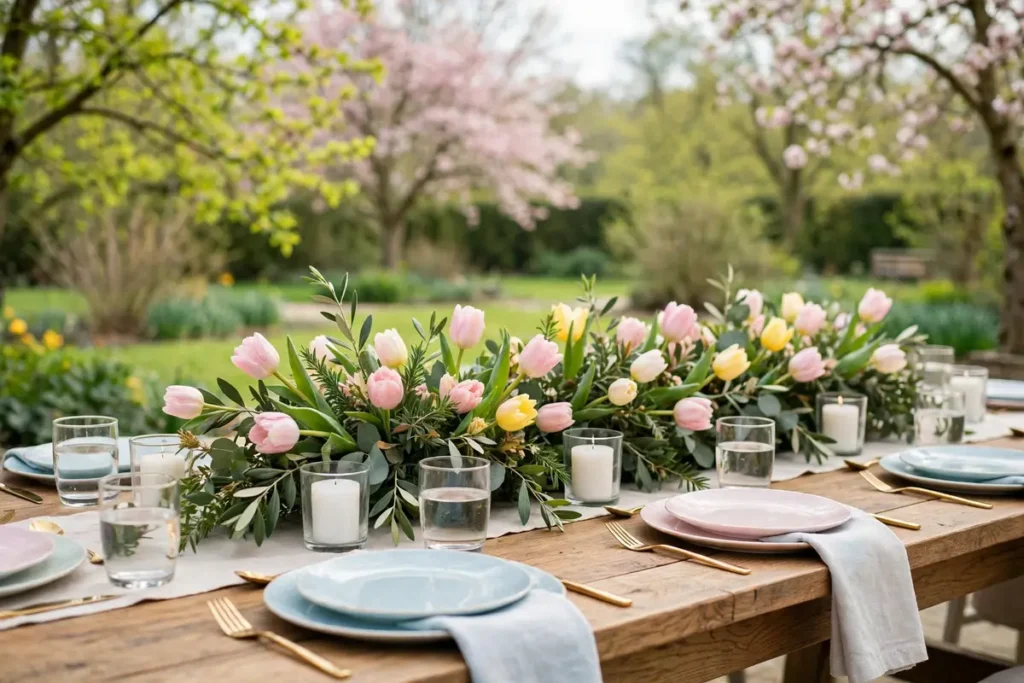
Spring centerpiece ideas are the fastest way I know to make a dining table feel ready for guests, because the centerpiece is the first thing anyone sees when they sit down. One March I set the table for a simple family lunch, plates, glasses, and nothing in the middle, and the table looked unfinished, even though the food was good. I put a low bowl of tulips in the center that afternoon, and the whole table felt like spring before anyone had even sat down.
I have tried every centerpiece in this list on my own dining table, or on a table very much like it. My table is not long and grand. It is a plain wooden table that seats six, with not much width to spare, which is why these ideas are practical. A centerpiece that works on a wide farmhouse table does not always work on a narrow one, and I will tell you where size mattered. Some took ten minutes and things I already owned. Some took an afternoon of trimming stems and moving candles an inch to the left, then an inch back. A few fought me, a tall vase blocked the view, a floating flower sank, a candle dripped on the runner, and I will tell you where that happened, because that is the part that saves you time.
If you want the wider table picture first, these spring tablescapes are a good place to start, and you can always come back to The Inspire Rooms homepage to browse. For now, pick one centerpiece, not all eighteen, and try it this weekend. A centerpiece that feels like spring makes the whole meal feel a little better, and that is really the whole point.
1. Keep It Low With a Tulip Bowl
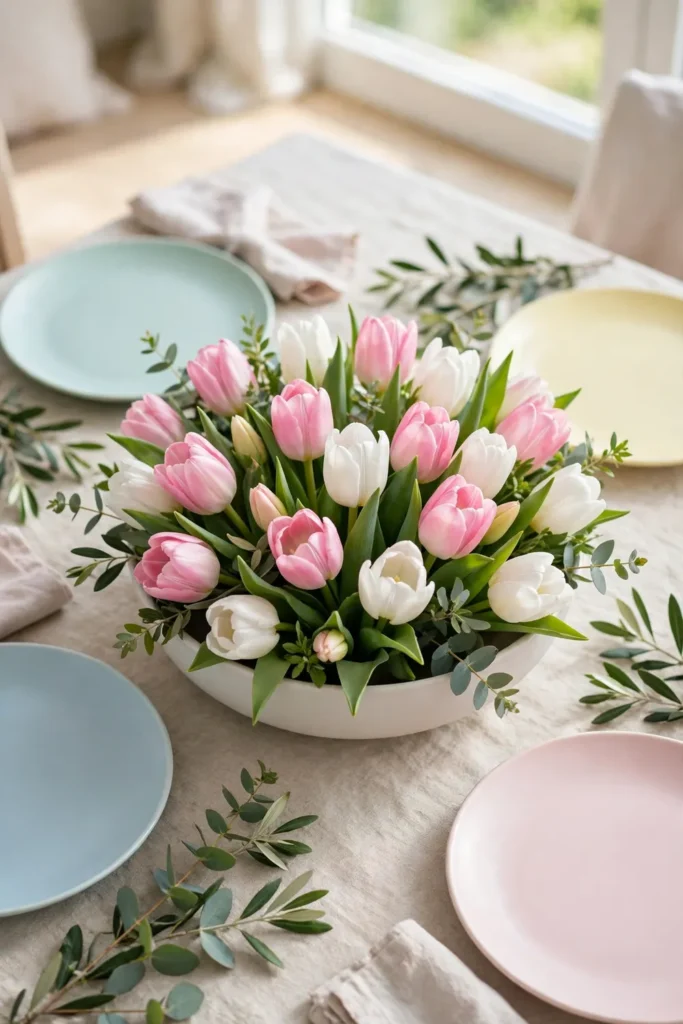
A spring centerpiece starts, for me, with a low tulip bowl. I cut tulips short, arrange them in a wide, shallow bowl, and set it right in the center of the table, where everyone can see over it and still talk across it. The tulips do not need anything tall around them. A low bowl plus a couple of small candles is enough, and the table looks cared for without feeling crowded.
My first tulip centerpiece was a tall vase, and nobody across the table could see each other properly. We kept leaning around it all through lunch, which was not the relaxed meal I had planned. A low bowl solved that in one move. For more easy spring centerpieces that stay low and simple, the Better Homes and Gardens spring centerpieces guide shows how different flowers sit in bowls and low containers.
Tip: Keep a low tulip centerpiece out of direct sun through a nearby window if you can. Heat shortens tulip life fast, and a shaded table keeps them looking fresh for days longer.
2. Run a Greenery Runner Down the Middle
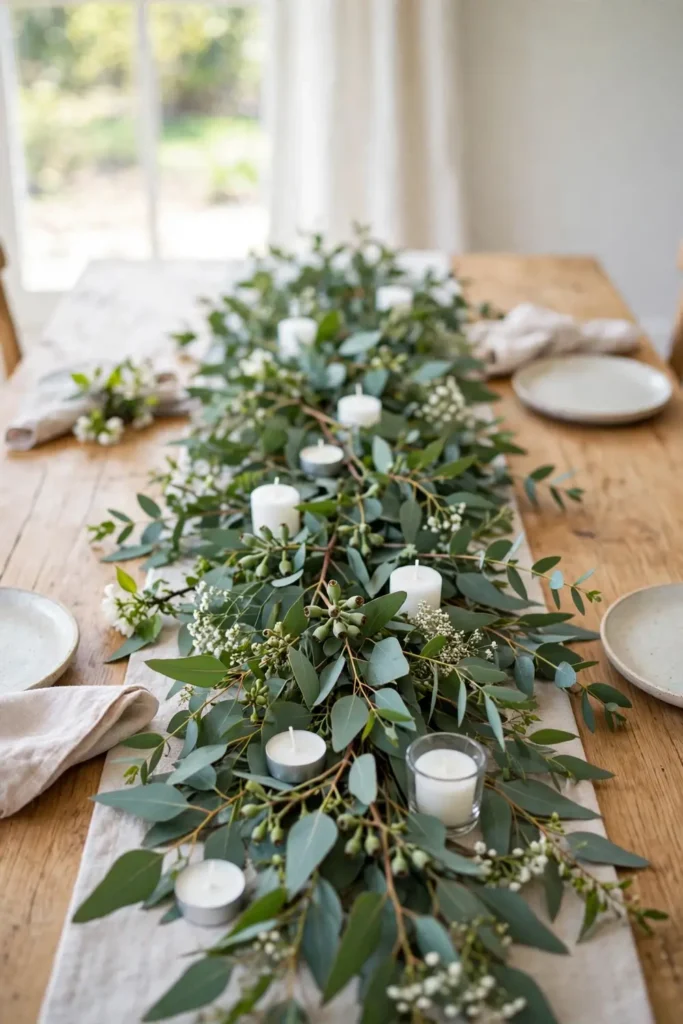
A greenery runner is the centerpiece for days when I do not want to arrange flowers at all. I lay fresh eucalyptus and soft greenery straight down the middle of the table, tuck in a few small white candles, and the table looks like spring before any plates go down. The greenery smells fresh, it lasts longer than cut flowers, and it leaves plenty of room for serving dishes on either side.
I used to pile greenery thick down the middle, thinking more green meant more spring, and there was no room left for the food. A thin, low runner, about a hand wide, with breathing room on both sides, works better. The same light, low feeling works on a full place setting too, and these spring table decor ideas use greenery the same way, without crowding the plates.
Tip: Put a thin cloth or runner under fresh greenery. Damp stems can leave a mark on a wooden table overnight, and a runner protects the wood while making the greenery look finished.
3. Cluster Three Bud Vases
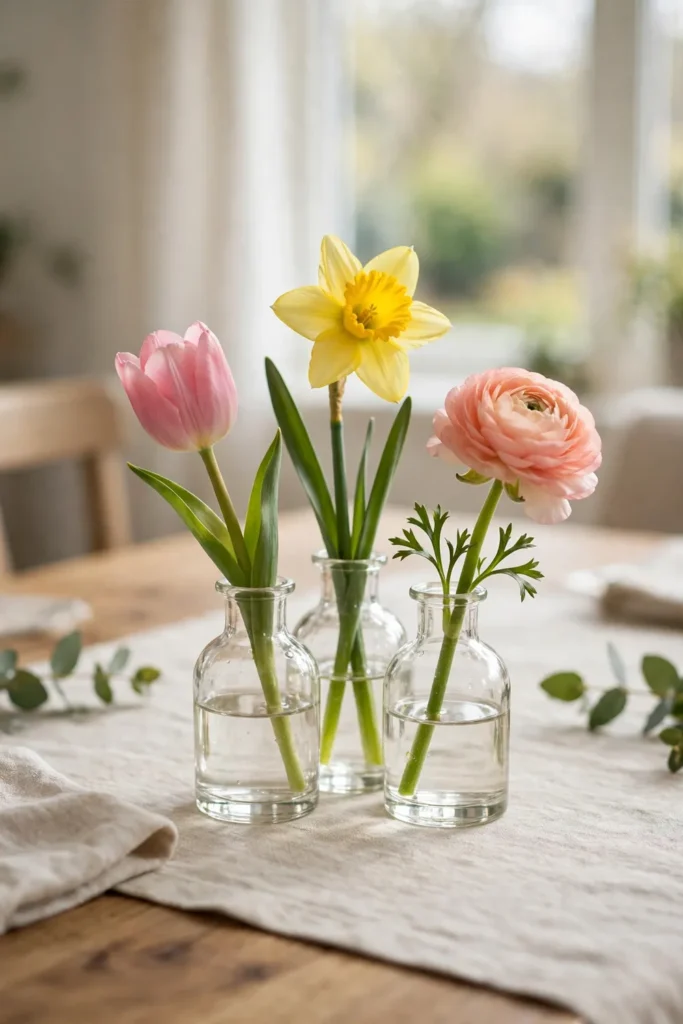
Three small bud vases beat one big arrangement on my table, every time. I use three clear glass vases, each holding a single stem, a tulip, a daffodil, and a ranunculus, and cluster them close together in the center. The group reads as one centerpiece from across the room, but up close you can enjoy each flower on its own. It is also cheaper than one large bouquet, and easier to refresh, because I can swap a single tired stem without rebuilding the whole thing.
I used to buy one huge mixed bouquet, stuff it into a tall vase, and watch it droop unevenly by day four. Small vases with one stem each last longer, because I can change the water in each one in under a minute. The cluster also fits a narrow table, where a wide bowl would take up too much room.
Tip: Use an odd number of bud vases, three or five, and vary their heights by just a little. Even numbers lined up in a row look like soldiers on parade, while a small height difference looks natural.
4. Fill a Dough Bowl With Moss and Eggs
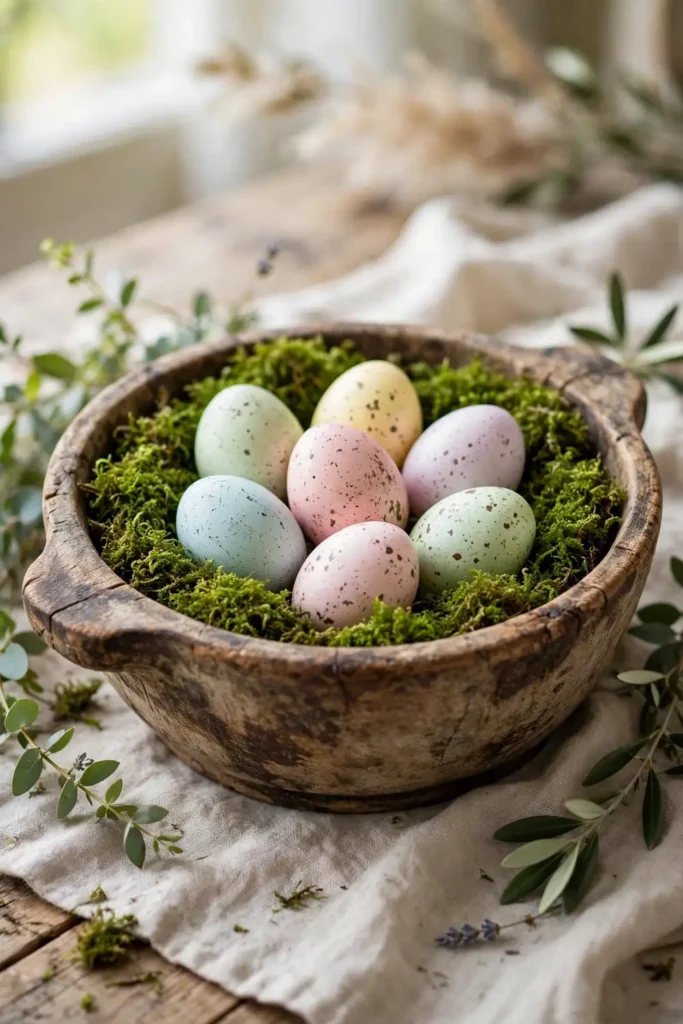
A dough bowl centerpiece is my Easter answer when I want spring without a riot of flowers. I fill a low wooden dough bowl with soft green moss, tuck in pastel speckled eggs, and set it in the center of the table with nothing else around it. The eggs say Easter, the moss says spring, and together they feel like a holiday without feeling like a shop window.
The bowl matters, because loose eggs on a table roll. I learned that when an egg rolled off the table and cracked on the floor, and I have kept eggs in a bowl ever since. A low, heavy dough bowl also stays put when someone reaches across the table, which a light basket does not always do.
Tip: Keep the eggs in the bowl, not scattered on the tablecloth. Scattered eggs look charming in photos and get knocked onto the floor every single time someone passes a dish.
5. Use a Cake Stand for Height
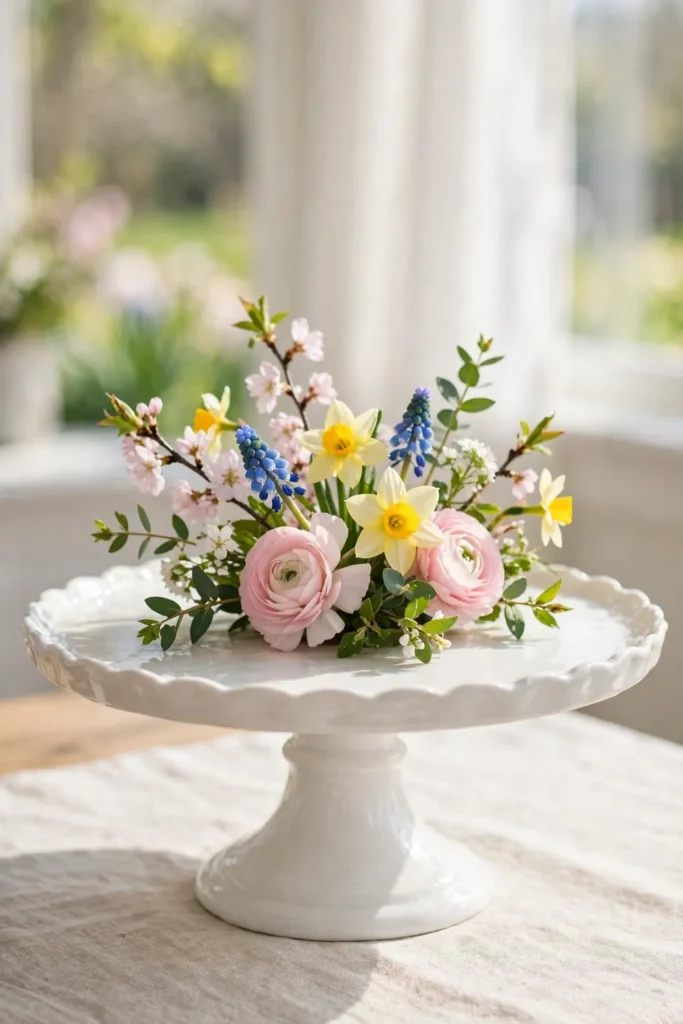
A cake stand is the centerpiece trick I use when I want height without blocking the view. I put a small arrangement of spring flowers on a white ceramic cake stand, and the flowers sit just high enough to be seen from every chair, but low enough that guests can still talk over them. The stand itself adds a little formality, which is useful for a Sunday lunch, without making the table feel stiff.
My first cake stand centerpiece was too tall, a tall stand plus tall flowers, and it blocked the view just like the tall vase had. A short stand, only a few inches high, with short stems, is the right balance. I also learned to put a small plate or cloth under the stand, because a ceramic stand can scratch a wooden table if it gets dragged across it.
Tip: Keep a cake stand centerpiece to one small arrangement, not a stand plus candles plus a runner plus a bowl. One raised piece is a focal point. Four raised pieces is clutter at eye level.
6. Float Flowers in a Glass Bowl
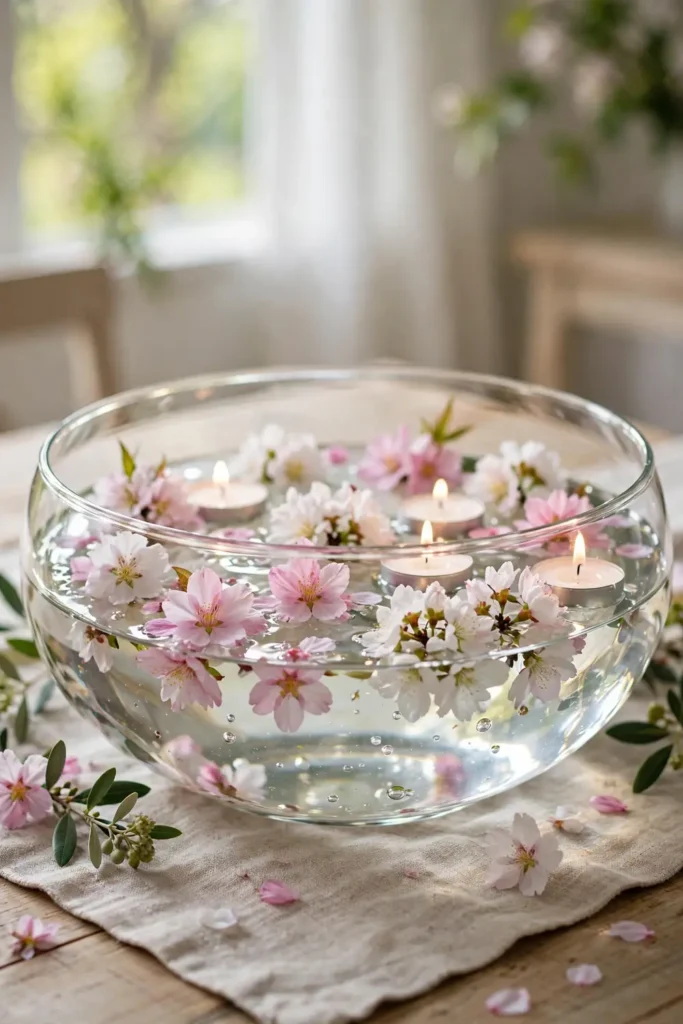
Floating flowers are the centerpiece for evenings when I want the table to glow. I fill a wide glass bowl with water, float a few flower heads on the surface, add two small floating candles, and the table looks soft and calm as soon as the candles are lit. The flowers need no arranging skill at all, which is part of the charm, because anyone can float a flower head in a bowl.
The first time I tried this, I used a deep bowl and the flowers sank to the bottom and looked sad. A wide, shallow bowl works better, because the flowers stay on the surface where they can be seen. For a step-by-step look at a simple bowl centerpiece, the Most Lovely Things simple spring centerpiece guide walks through a bowl, natural elements, and fresh blooms in plain language.
Tip: Change the water every day and float fresh flower heads. A bowl of cloudy water with drooping flowers looks tired, while fresh water and fresh blooms look like you just made it.
7. Line Up Herb Pots as a Centerpiece
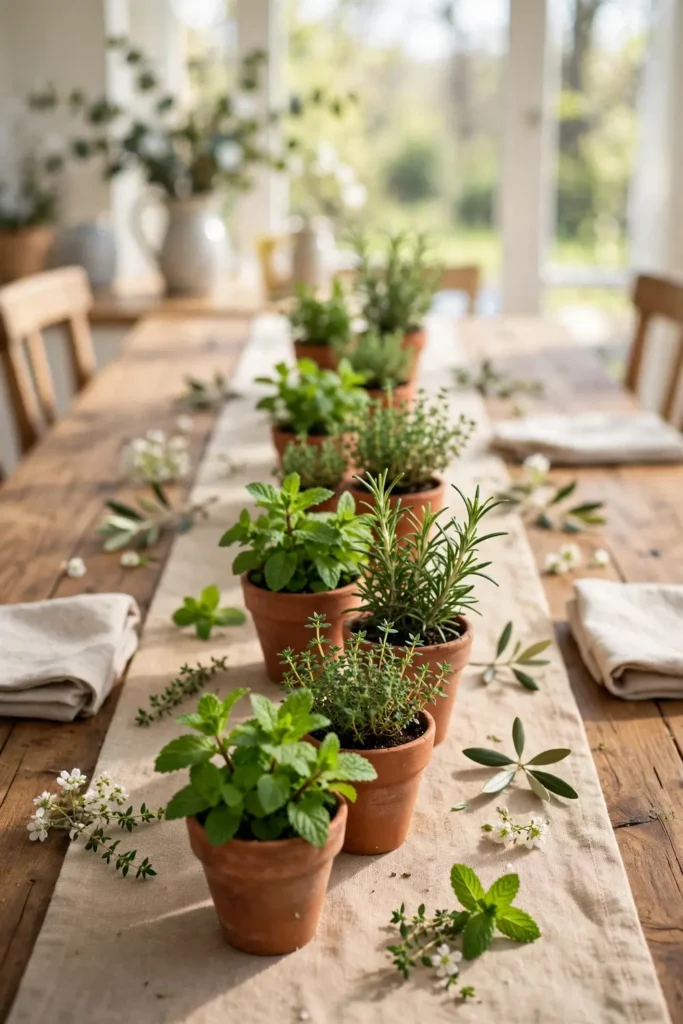
A herb centerpiece is my favourite practical centerpiece, because it is decoration and a kitchen garden at the same time. Rosemary, thyme, and mint in small terracotta pots, lined down the center of the table, smell wonderful when you lean in, and I can snip a little for cooking without ruining the display. It smells like a garden, not like a flower shop, and guests always comment on it.
I water the pots lightly before guests arrive, because herbs in small pots dry out faster than herbs in the garden. I also keep the pots small, no bigger than my hand, because a big pot of herbs on a table looks like a garden that lost its way indoors. Small pots, lined up neatly, and the table holds its shape all through the meal. Rosemary lasts longest, mint fades fastest, so I put mint where I can replace it easily, at the end, not buried in the middle.
Tip: Put a small tray or saucer under each pot. Water that drains onto a tablecloth leaves a damp ring, and a damp ring in the middle of the table is very hard to ignore.
8. Add Candles in Glass Hurricanes
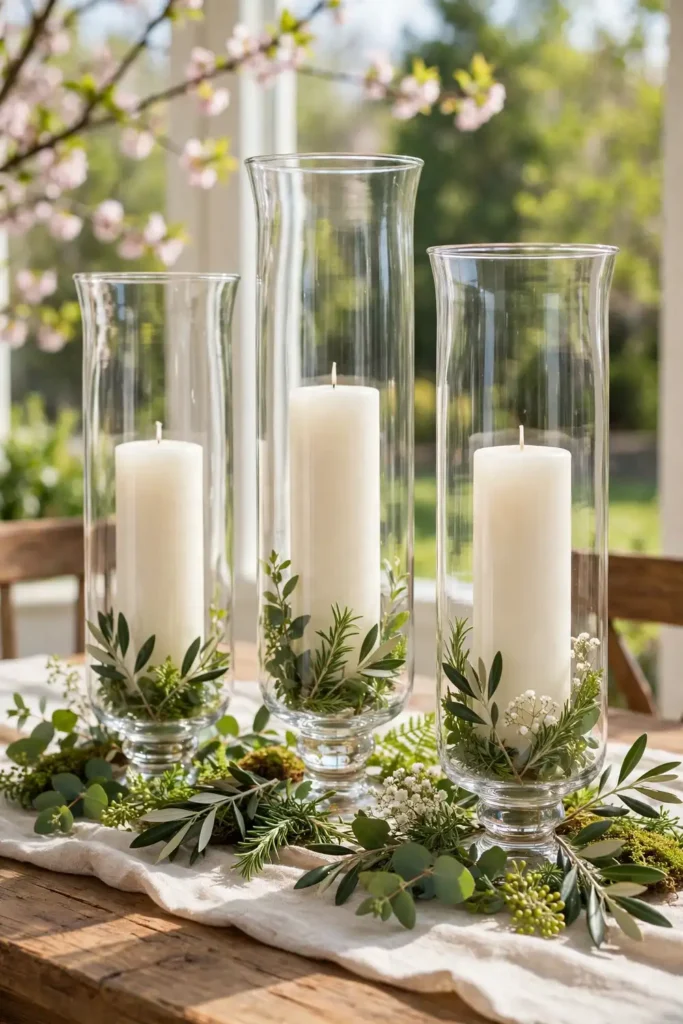
Glass hurricane candles are the centerpiece when I want glow without flowers taking over. I set two or three glass hurricanes of different heights down the center of the table, with white pillar candles inside and a little greenery at the base of each one. The glass protects the flame from draughts, so the candles stay lit through the whole meal, and the light through the glass looks soft on the table.
I used to set bare pillar candles on the table, and the wax dripped onto the runner every time. Hurricanes catch the wax and keep the table clean, which is a practical bonus. I also learned to keep the hurricanes away from the edge of the table, because a hurricane knocked over by someone reaching for a dish is a mess of glass and wax nobody needs.
Tip: Use unscented candles for a dinner centerpiece. A strongly scented candle competes with the food, and guests should smell dinner, not the candle.
9. Add Lemons to a Greenery Centerpiece
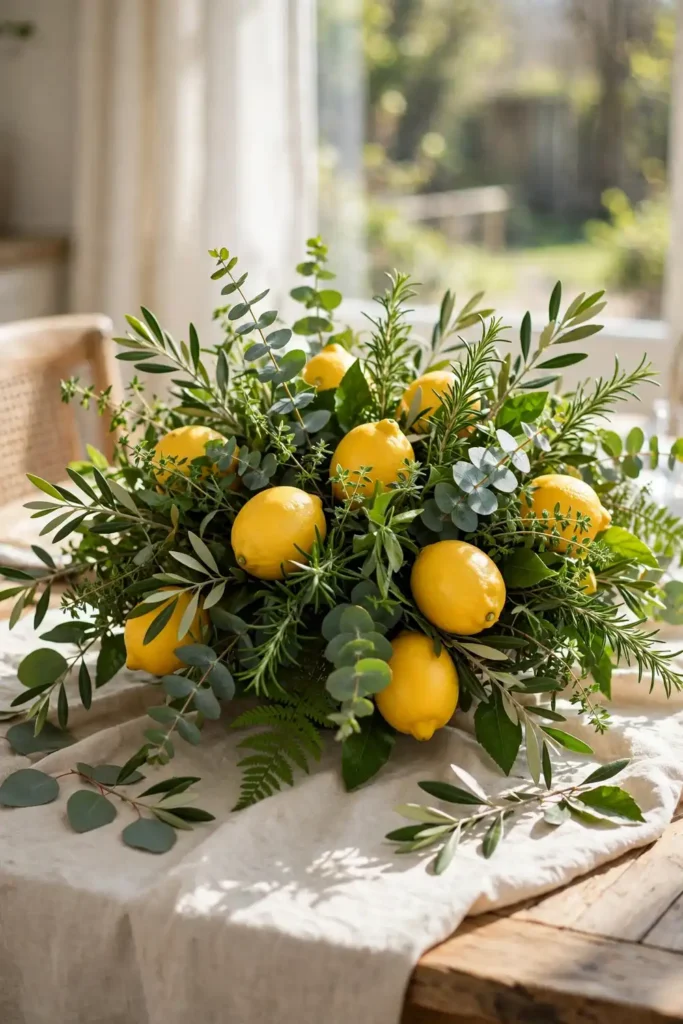
Lemons are the centerpiece for days when I do not want to arrange flowers at all. Whole lemons tucked into a greenery runner, with a few leaves for contrast, and the table looks sunny before anyone sits down. The lemons smell clean and sharp when you lean in, and I can cook with them later in the week, which feels practical, not wasteful.
I wire or nestle each lemon into the greenery, because a lemon resting on leaves rolls off the first time someone bumps the table. I also turn the prettiest side of each lemon outward. A dull lemon in the middle of the centerpiece is the first thing your eye finds, and not in a good way. The rest of the centerpiece stays plain greenery, because the yellow is already doing plenty of work.
Tip: Mix whole lemons with leaves, not more fruit. A centerpiece of only lemons looks like a fruit bowl that wandered onto the table. Leaves make it look like a centerpiece.
10. Use a Wooden Tray to Anchor It
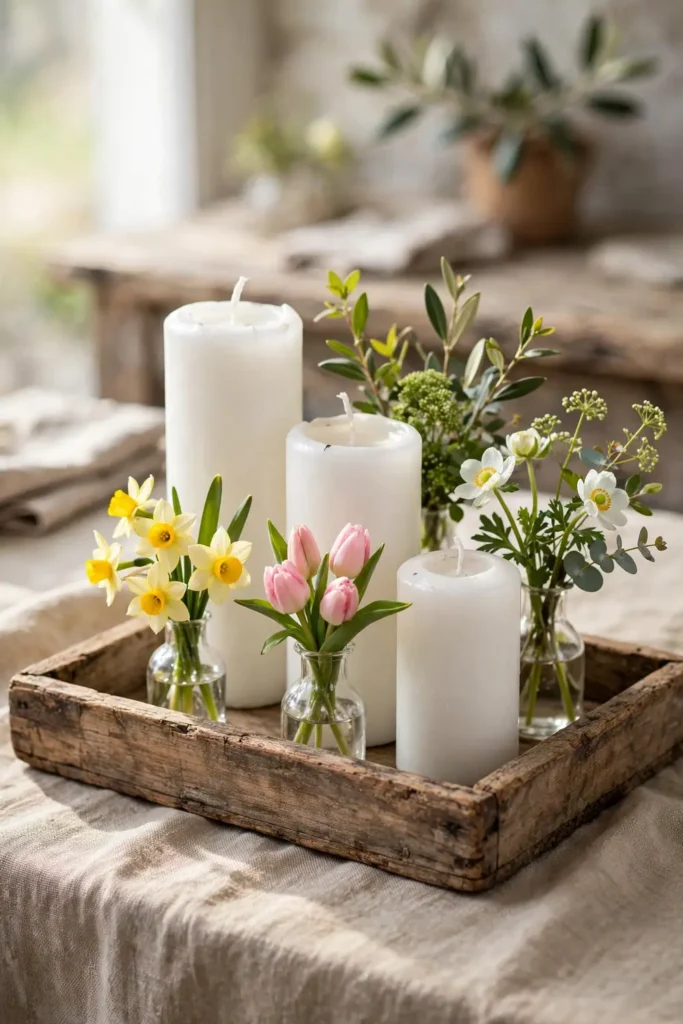
A wooden tray is the centerpiece anchor I use when the table feels scattered. I put candles, a small vase, and a little greenery on one wooden tray in the center of the table, and suddenly the small pieces read as one display instead of three separate things. The tray also makes the centerpiece easy to move, which matters when I need the table space for serving dishes.
My first tray centerpiece failed because I used a tray that was too big, and it took up half the table. A tray that leaves room for plates and glasses on both sides is the right size. I also learned to line the tray with a cloth if the candles might drip, because wax on a wooden tray is hard to clean, while wax on a cloth is not.
Tip: Keep the tray to three items, no more. Candles, one vase, and a little greenery look like a display. Five or six items on a tray look like a drawer that was emptied onto the table.
11. Put Cherry Blossom Branches in a Low Vase
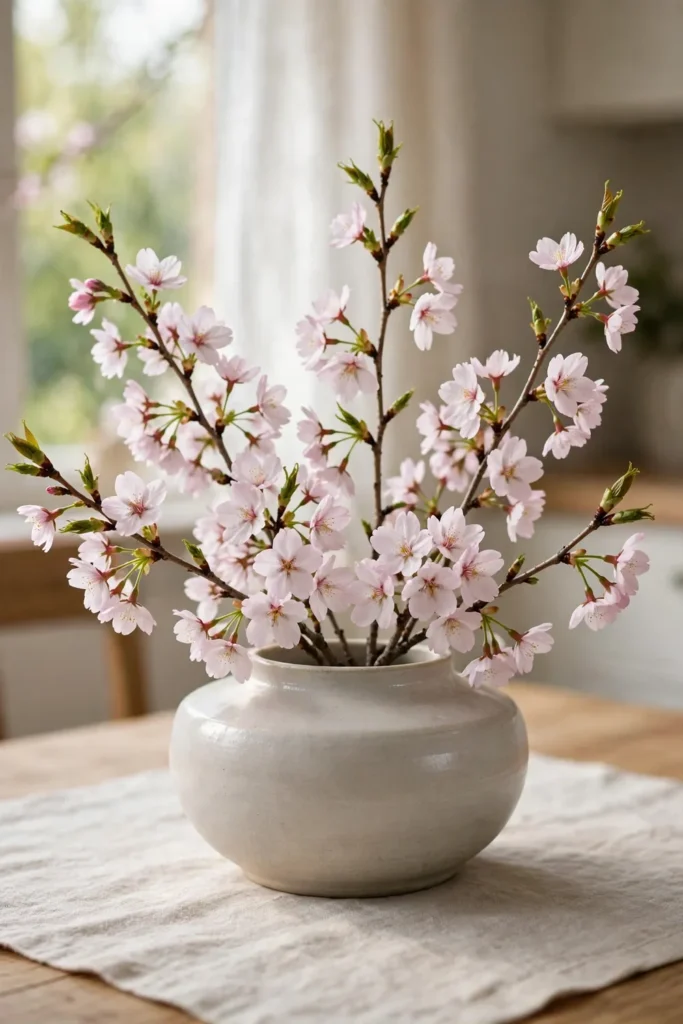
Cherry blossom is the one centerpiece where I break my own low-and-even rule, and I break it on purpose. A low vase of pale pink cherry blossom branches, airy and a little wild, with room to breathe between the blooms, gives the table drama without blocking the view. You can see through the branches, and still feel like you are sitting under a tree in bloom.
The vase has to be heavy, because branches are top heavy on a table, and a light vase tips when someone brushes past. I learned that with branches on the tablecloth and blooms everywhere, and I have used a heavy ceramic vase ever since. A few low green leaves at the base hide the stems and make the branches look like they belong on the table, not like they wandered in from the garden.
Tip: Keep cherry blossom to one vase, not a vase plus a branch runner plus a branch print on the wall. One airy statement is drama. Three airy statements is a forest, and nobody can see across the table in a forest.
12. Mix Peonies With Eucalyptus in a Footed Bowl
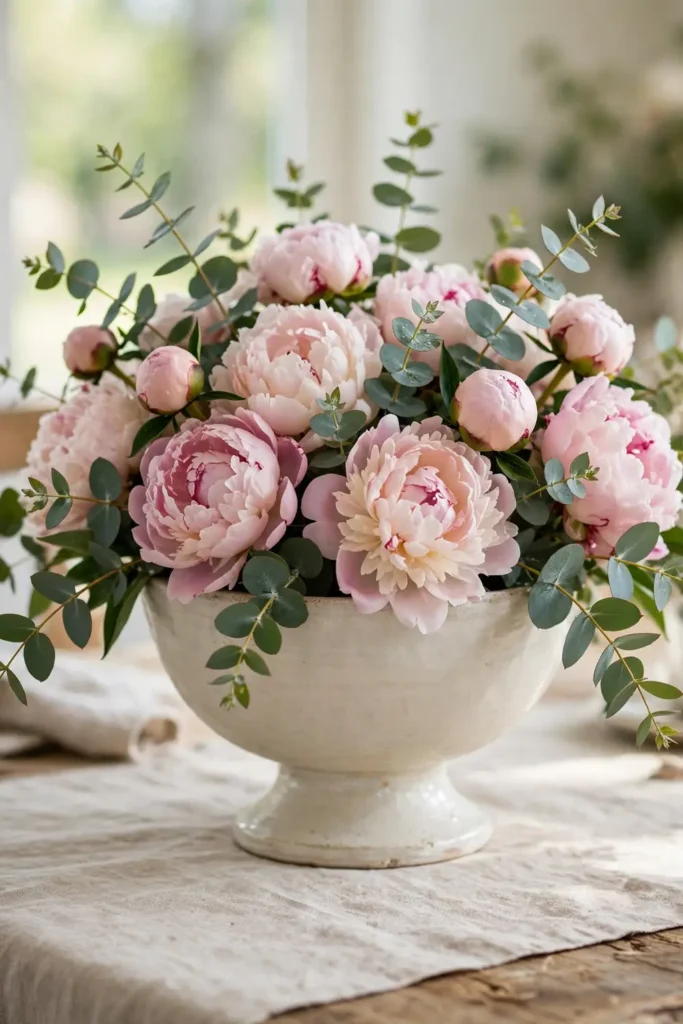
Peonies mixed with eucalyptus are the centerpiece I save for a special evening. Blush peonies, low and full, with soft silver-green eucalyptus tucked around them, in a footed bowl, and the table looks ready for guests before anyone has even arrived. The peonies are soft and a little extravagant, and the eucalyptus keeps them from looking too formal, which is exactly the balance I want for a spring dinner.
Peonies open fast in a warm room, which is both lovely and a little stressful. I buy them a day early, keep them cool, and put the bowl on the table an hour before guests arrive, so they are open but not dropping petals all over the tablecloth. A few petals on the table are charming. A pile of petals on a plate is not, and I have learned to check before I sit down to wait for guests.
Tip: Use a sturdy footed bowl for peonies. Peonies are heavy for their size once the blooms open, and a light bowl tips easily if someone reaches across the table.
13. Create a Wildflower Meadow Tray
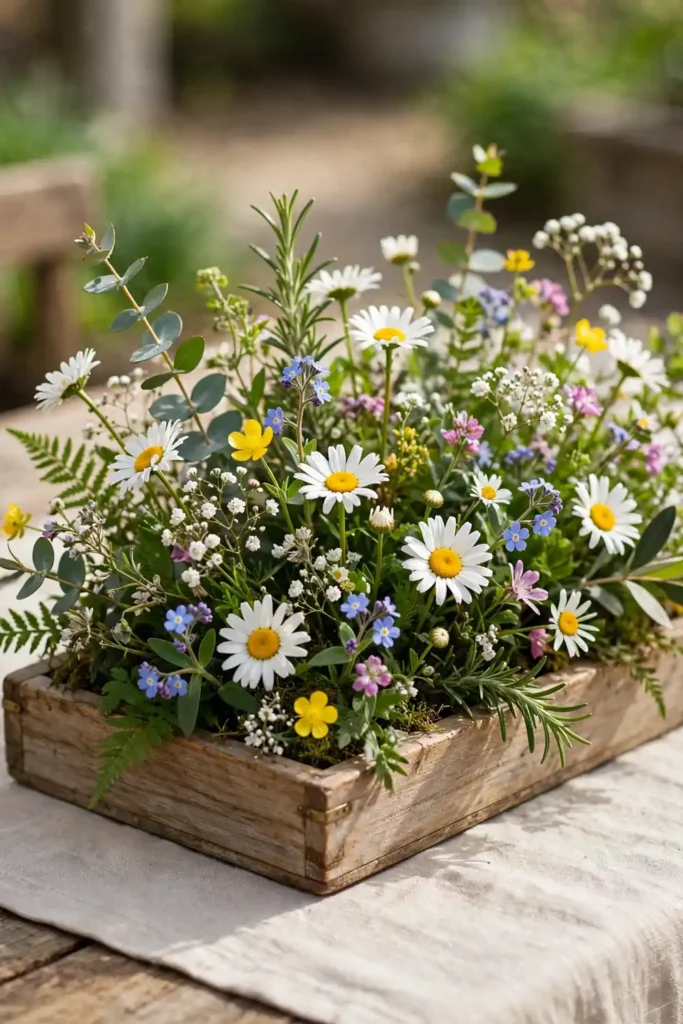
A wildflower centerpiece should look gathered, not arranged, and that line is thinner than it looks. Mine uses a shallow tray, small daisies and mixed spring flowers in different heights, and a little greenery, all tucked in loosely. The flowers do not match, and that is the point. It looks like someone walked outside and came back with flowers, which is more or less what happened.
I vary the heights a little, a tall stem here, a short one there, so the tray has a rhythm to it. Same height flowers all the way across look like a factory line. Different heights look like a meadow edge, and they also let the tablecloth show through in places, which matters more than perfect symmetry. I also leave a little space between stems, because flowers crammed shoulder to shoulder look like a shelf in a shop, not a centerpiece at home.
Tip: Fill the tray with greenery first, then add flowers. Greenery hides the base and gives flowers something to sit in, and you will need fewer flowers than you think to make it look full.
14. Use Lavender Bundles in a Pitcher
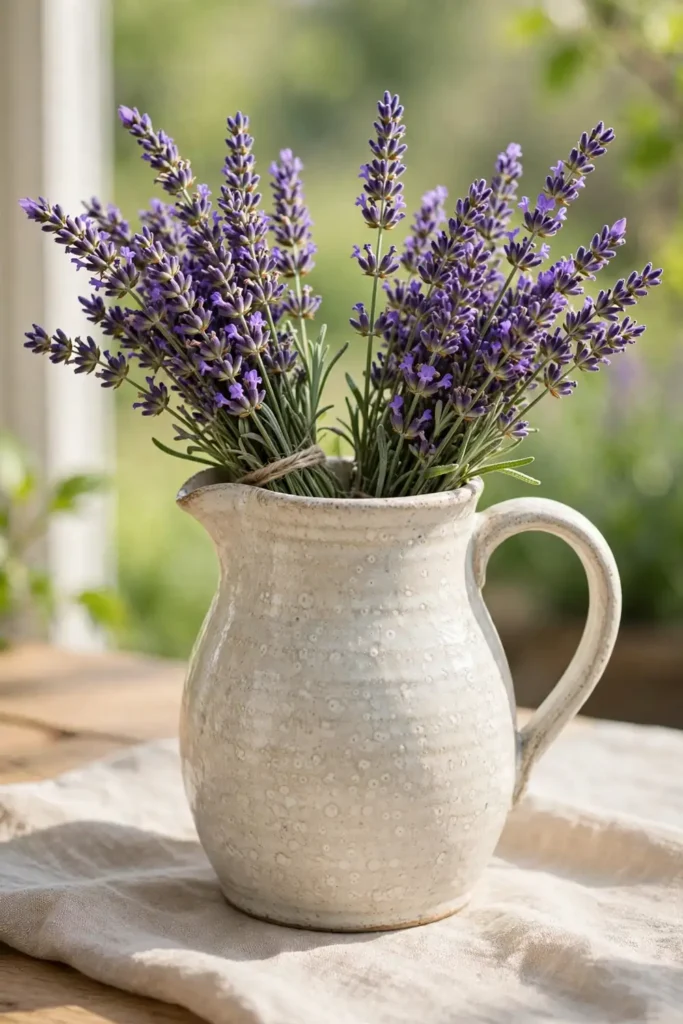
Lavender is the calmest centerpiece I use. Small bundles of purple lavender, tied with twine, standing in a ceramic pitcher in the center of the table, with one white candle beside it. It smells wonderful when you lean in, and it looks quiet next to a busy table setting. It does not shout spring, it whispers it, and on a table that already has colourful plates, that whisper is exactly right.
Lavender dries well, which is part of its charm. I set it out fresh, enjoy the scent for a week or two, and then let it dry right on the table. Dried lavender keeps its colour for a long time if it stays out of harsh sun, and it keeps a little scent too. The first lavender centerpiece I made, I took it down when it started to dry, thinking it was done. It was not done. It was just entering its second, longer life.
Tip: Handle lavender gently when you set the pitcher down. The small buds shed if you shake a bundle hard, and a trail of purple buds on the tablecloth is pretty for a day and a sweeping job after that.
15. Keep a Small Table Simple With One Vase
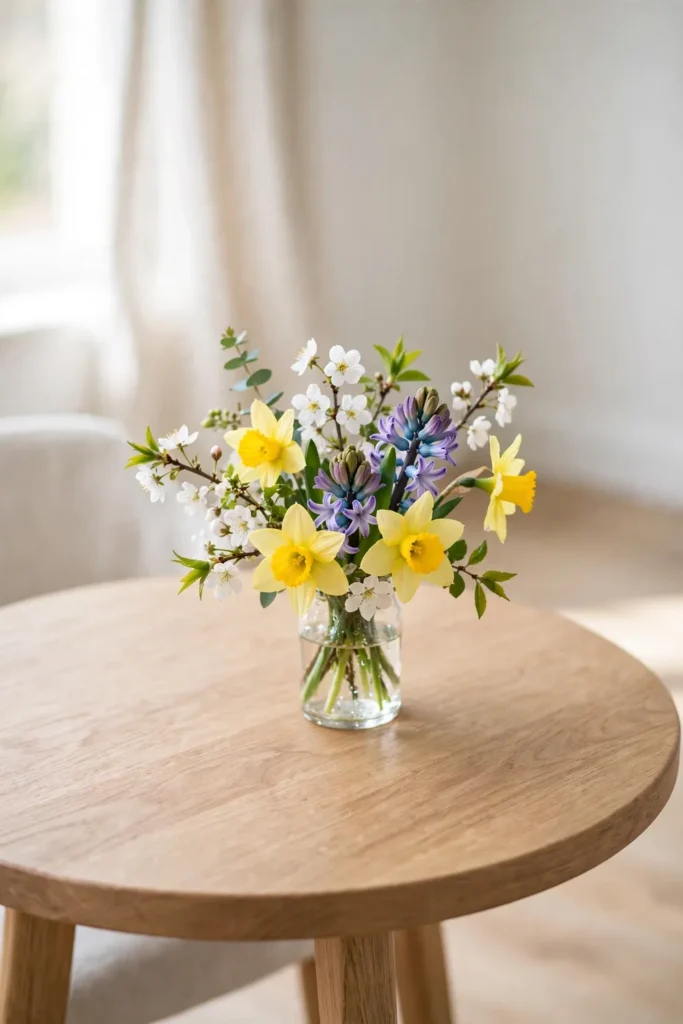
A small table is my favourite kind of centerpiece challenge, because it proves you do not need a long table at all. I styled a friend’s small round table with just one tiny vase of spring flowers, and her lunch felt like spring without a single runner, lantern, or stack of books. One vase in the center is enough, and sometimes it is better than a full display, because a small table has no room for clutter.
We chose a vase that fit the table, not a wide bowl that left no room for plates. The vase was light and simple, because a heavy, busy centerpiece on a small table looks out of proportion, like a big hat on a small person. The same light touch works on a fireplace shelf too, and these spring mantel decor ideas use it on a mantel, where space is just as tight.
Tip: Measure your table before you buy anything for it. A vase that looks small in a shop can look huge on a small table, and a quick measurement saves a return trip.
16. Pair Lanterns With a Low Garland
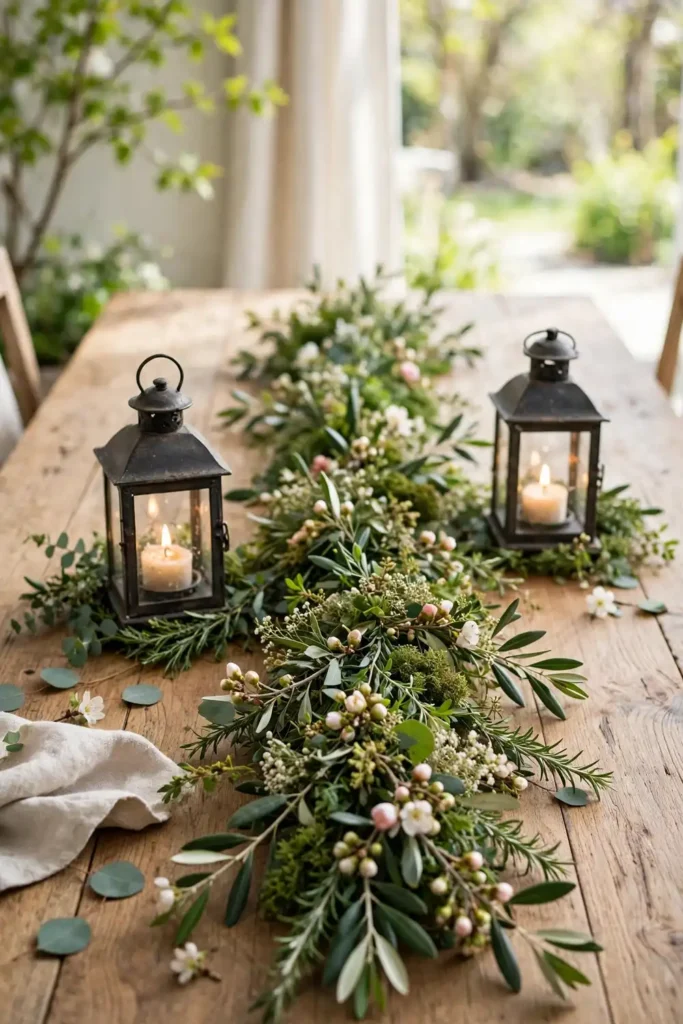
Lanterns paired with a low garland are how I give a long table anchors without making it look busy. I put two small lanterns, one at each end of the centerpiece, with a low greenery garland between them, and the table suddenly looks ordered, not scattered. The lanterns give the eye somewhere to land at both ends, and the garland ties them together in the middle.
I place both lanterns at the same distance from the ends, measured with a tape, not by eye, because lanterns placed by eye always end up uneven, even when they look even while you are standing right in front of them. I also use battery candles inside table lanterns if the table is crowded, and keep real flames well away from any greenery. A pretty table is never worth a fire risk.
Tip: Keep the garland low and the lanterns small. Tall lanterns plus a tall garland block the view across a long table, while low lanterns and a low garland frame it.
17. Refresh With a Ribbon on the Vase
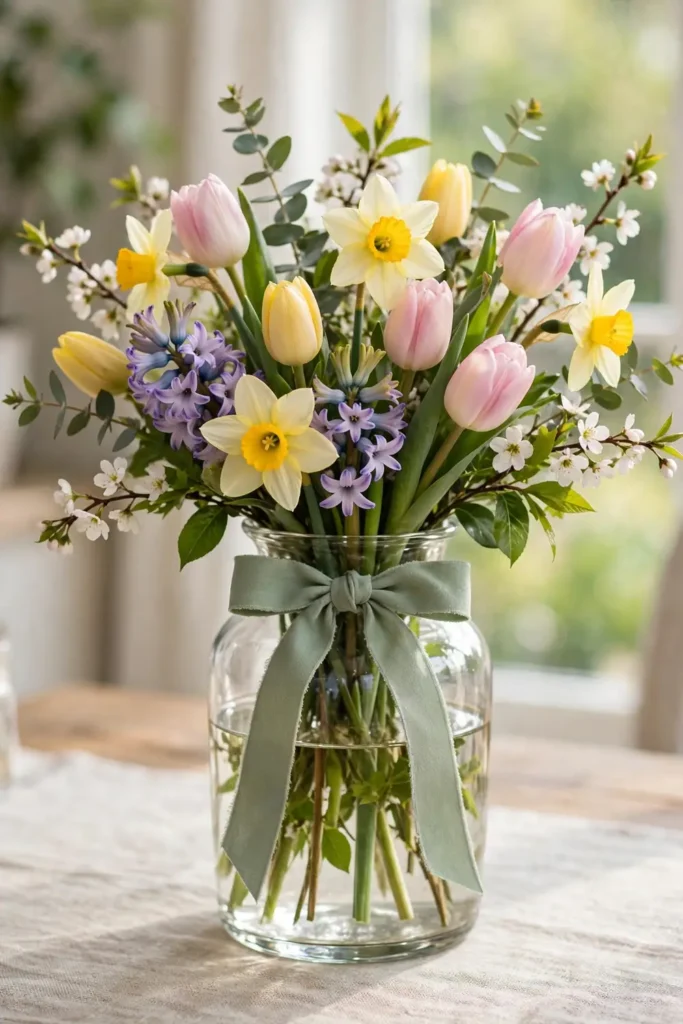
A ribbon is the cheapest refresh I know for a spring centerpiece. I take a plain glass vase of flowers, one I have used for a week, and tie a simple ribbon bow around the neck of it, and suddenly the whole table looks new again. The bow adds colour and a soft, finished feeling, without buying new flowers or a new vase. It is the trick I use when guests are coming and I have ten minutes, not a whole afternoon.
I use wired ribbon, because plain ribbon flops and loses its loops by the next day, especially near an open window. Wired ribbon holds its shape, and I can fluff the loops after dusting without retying the whole bow. I also tie the bow to the vase itself, not just to a few stems, because a bow tied to stems pulls them out of the water and leaves a bare patch right where you wanted a bow.
Tip: Keep the bow tails short enough that they do not dip into the water or hang over a plate. Long tails look pretty in photos and get in the way every single time someone reaches for food.
18. Choose Dried Flowers for a Centerpiece That Lasts
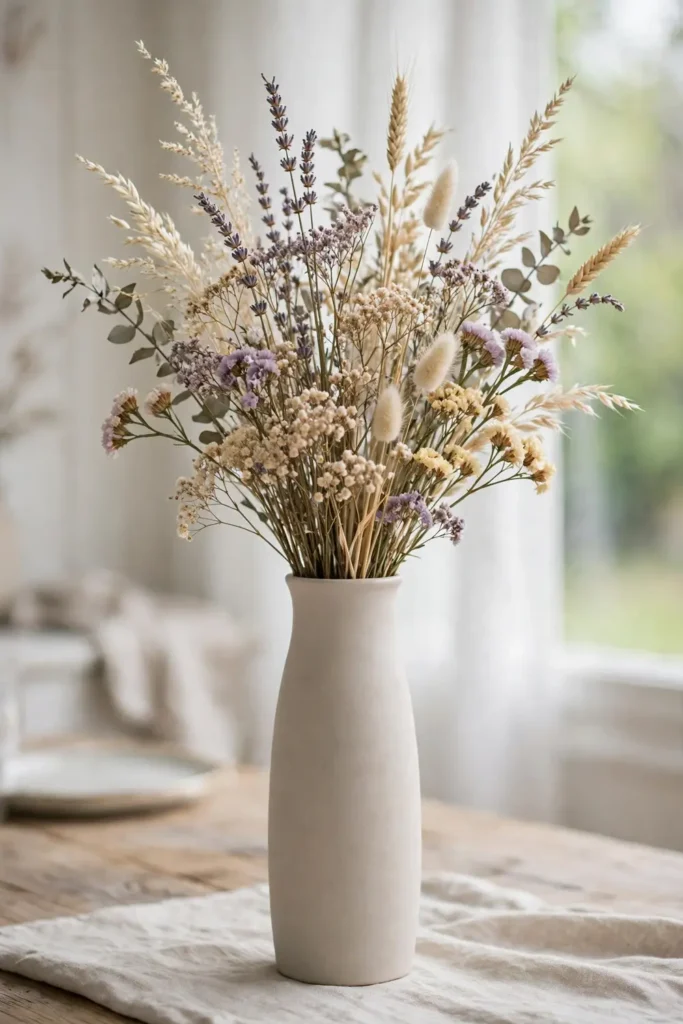
A dried flower centerpiece is the one I use when I want spring to last, not just bloom for a week. Dried blooms and grasses in soft, muted colours, with a little greenery, look gentle on the table, and they need no water, no misting, and no swapping of tired stems. They are the low-maintenance answer to a fresh centerpiece, and on a table away from heat they can last the whole season and into the next.
I handle a dried centerpiece gently, because dried stems are brittle and they shed if you shake them hard. I place it once, away from the kitchen heat and out of harsh sun, and I leave it alone. A light mist of hairspray, from a distance, helps hold the small blooms in place, but a heavy spray makes the arrangement look stiff and a little shiny, which is not the soft look I want.
Tip: Keep a dried centerpiece out of heavy draughts from an open window. A display that sways and sheds every time the window opens never quite keeps its first shape, which is a shame for a centerpiece you liked in March.
Frequently Asked Questions About Spring Centerpieces
What should I put in the center of my table in spring?
Low flowers, greenery, candles, and one seasonal detail are a good starting point, because they look like spring and they are easy to swap. Fresh tulips and greenery look best but need water and shade. Candles, lanterns, and dried flowers last longer and need less care. Choose pieces that fit your table, not too big for a small table and not too small for a long table, and sit down in a chair to judge the view across it.
How tall should a spring centerpiece be?
Low enough that guests can see and talk over it across the table. A centerpiece taller than about a foot in the middle of the table blocks faces and conversation. If you want height, use airy branches that the eye can see through, or set a taller piece off to one side rather than dead center.
How long do fresh spring centerpieces last on a table?
Fresh flower centerpieces usually last one to two weeks on a table away from heat, less in direct sun. Greenery and eucalyptus last longer, often several weeks. Dried and preserved centerpieces last the whole season and longer, if they stay out of heat and heavy draughts. Change the water every day or two, and swap tired stems instead of waiting for the whole centerpiece to fade.
Can I make a spring centerpiece on a budget?
Yes. Start with greenery you already own or a plain bowl, use jars and vases from around the house, and spend on one thing only, usually a bunch of flowers or a spool of wired ribbon. A ribbon bow refreshes an old vase, a few fresh stems refresh a greenery runner, and a clean tablecloth costs nothing and makes any centerpiece look better.
A spring centerpiece does not need to be perfect, and mine never are. A stem always sticks out a little, a bow always leans a touch, and a flower always droops by the end of the week. That is not a failed centerpiece. That is a centerpiece that was actually set on a table, by a real person, for a real meal, in real spring weather, and that is the best kind of centerpiece there is.
Pick one centerpiece from this list, try it this weekend, and see how it feels when you sit down to eat. If it works, keep it. If it does not, change one thing, the flowers, the ribbon, the height of a vase, and try it again. Spring centerpieces are meant to be tried, not just looked at, and the centerpiece that feels like spring is the one you eat beside every day.