
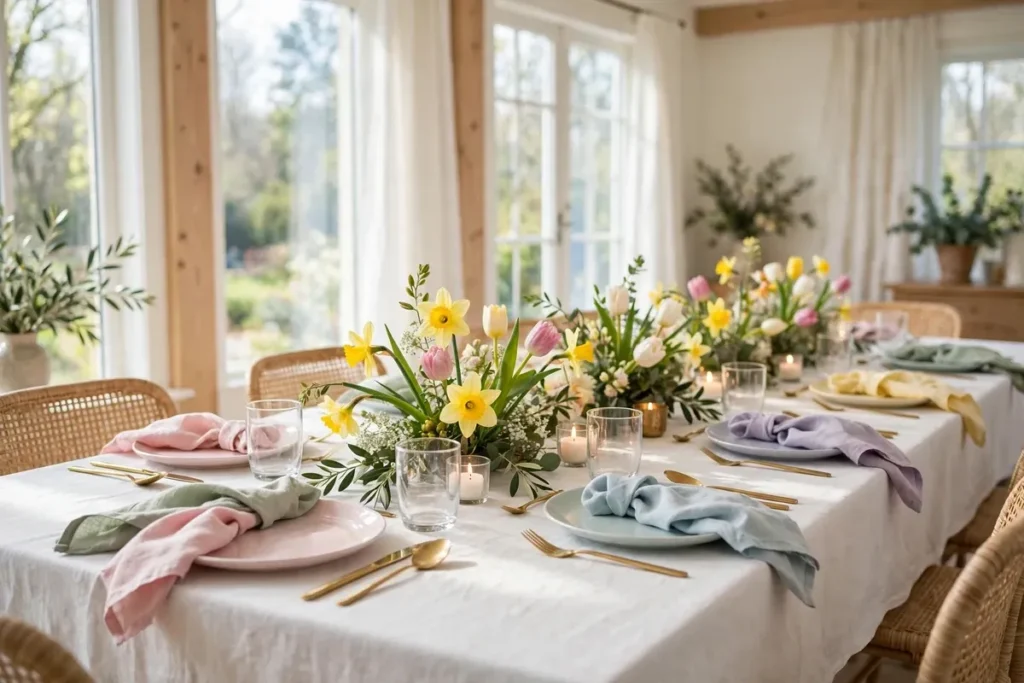
Spring tablescapes sound fancier than they are. When I first heard the word, I pictured a magazine shoot with a stylist, a photographer, and a table I would never dare eat at. Then I realized a tablescape is just the whole table, thought about as one thing, instead of a bunch of separate pieces that happen to land on the same cloth. The plates, the flowers, the napkins, the candles, and the little gaps between them all count. Once I started thinking that way, my own table got easier, not harder, to set.
I have tried every idea in this list at my own plain wooden table. Nothing here needs a new dining set or perfect light. Most use things I already owned, plus one bunch of flowers or one small change. Some came together in ten minutes. A few fought me, a runner slid, a candle leaned, a vase was too tall, and I will tell you where that happened, because that is the part that saves you time.
If you are just starting out with spring tables, these spring table decor ideas are a good place to begin, and you can start back on The Inspire Rooms homepage any time you want to browse. For now, pick one tablescape, not all eighteen, and try it at your next meal. A table that feels like spring is a table people want to sit at a little longer, and that is really the whole point.
1. Build the Whole Table Around One Low Tulip Centerpiece
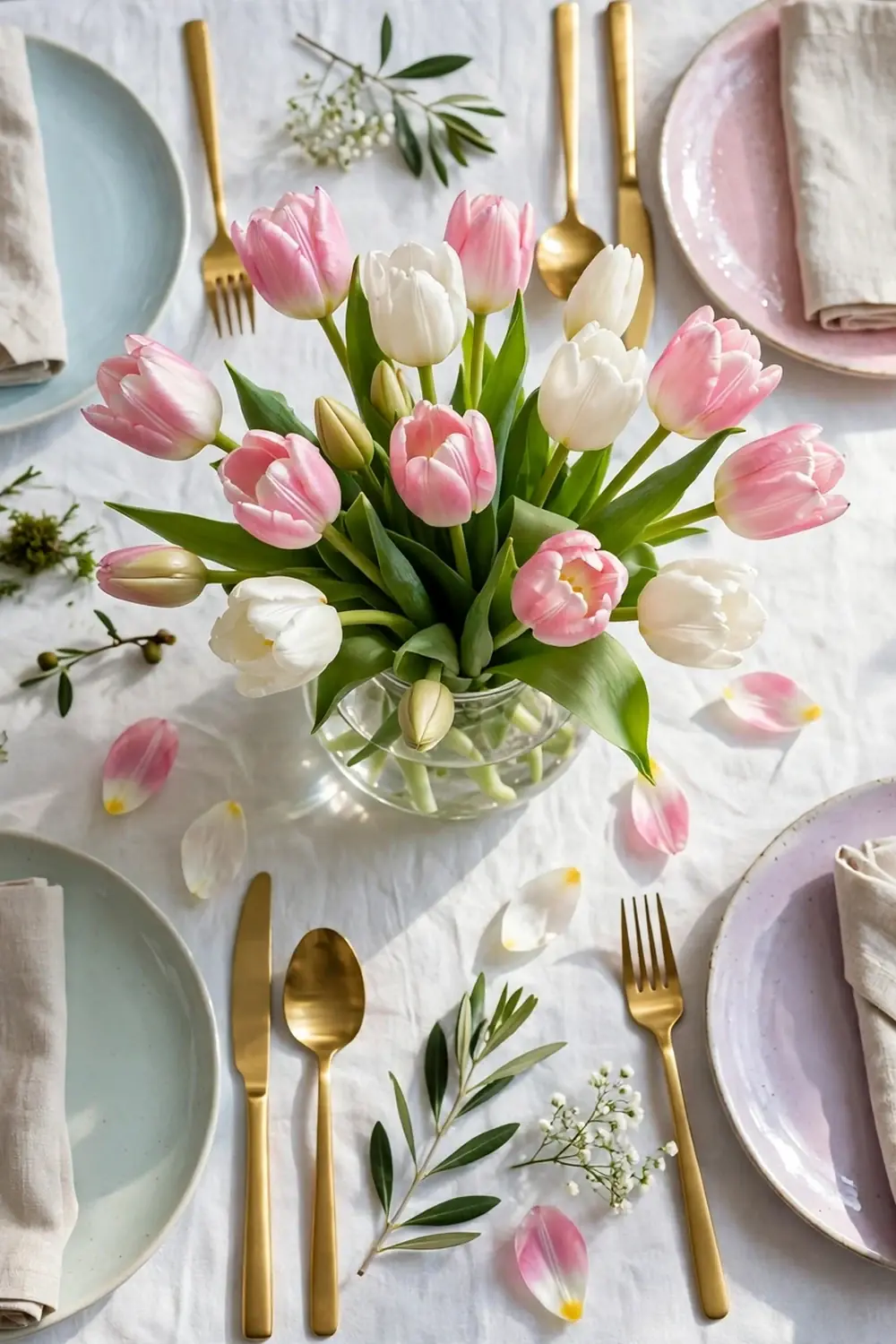
I start with the flowers, and then I let everything else follow them. A low glass vase of pink and white tulips sits in the middle, and suddenly the plates, the napkins, and even the glasses have a color to answer to. Pink napkins would be too much with pink tulips, so I use cream linen instead, and I let the tulips do the talking.
The trick is keeping the vase low. My first spring tablescape had a tall bouquet in the middle, and my sister and I spent the whole meal leaning sideways to see each other. A low vase means you can talk across the table without a wall of stems in the way, and it also means the table looks full without feeling crowded.
Tip: Put the vase down first, then set the plates around it. If you set the plates first, the vase always ends up squeezed into whatever space is left, and it shows. If you want a step-by-step tulip arrangement to follow, the Flower Magazine tulip centerpiece guide shows how to build one in a low container.
2. Let Pastel Plates Set the Mood for the Entire Table
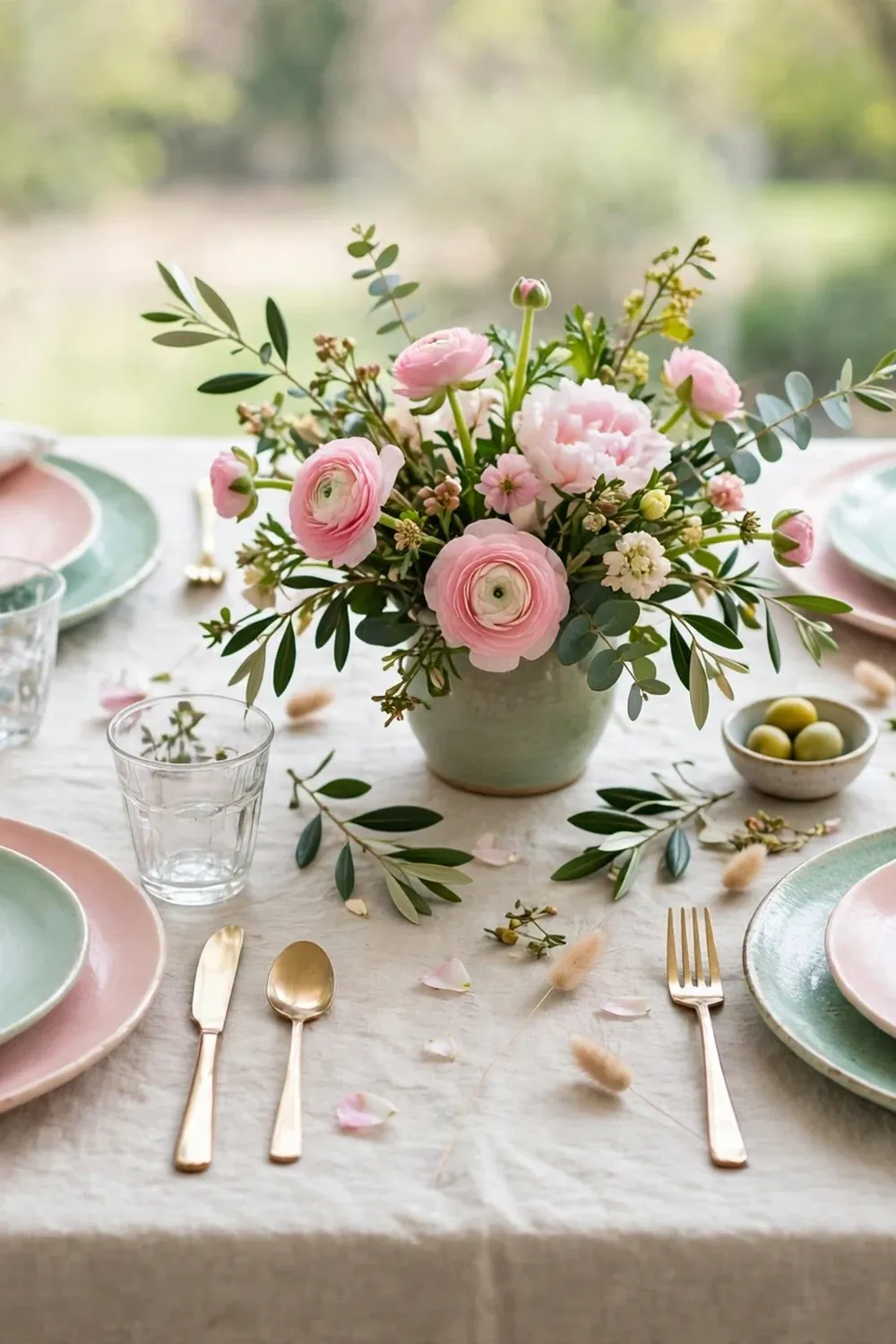
Pastel plates changed how my table photographs, and how it feels to sit at, more than any single purchase I have made for it. I do not own a full pastel set. I own four salad plates, two pink and two mint, and I stack one on a plain white dinner plate at each place. The white plate grounds the setting, and the pastel plate on top gives it a spring color without turning the table into a candy shop.
I keep the rest of the table quiet when the plates are pastel. Cream napkins, clear glasses, and one small flower at each place, nothing else competing for attention. The first time I tried this, I added patterned napkins too, and the whole table looked busy, like everyone was shouting at once. Quiet napkins, loud plates, that is the balance that works for me.
Tip: Mix pink and mint at the same table if you like, but keep the same pattern on both. Two different patterns in pastel still look like a mistake, even in soft colors.
3. Run Greenery Down the Middle and Keep Everything Else Simple
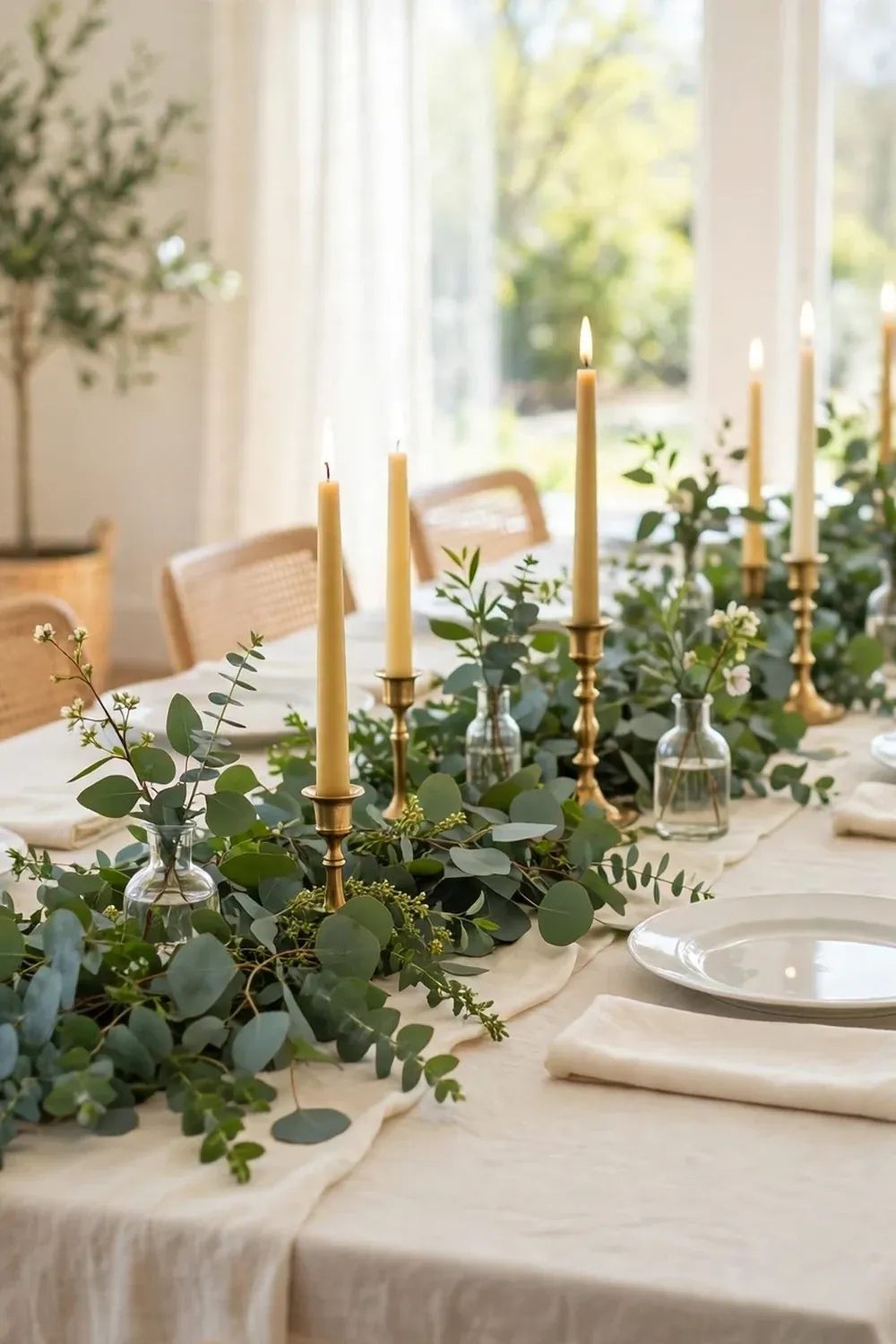
Greenery is the most forgiving centerpiece I know. I lay soft eucalyptus branches down the middle of the table, overlapping them so there are no bare patches, and then I stop. No flowers needed, no tall vase, just green running from one end to the other. It smells faintly fresh when you sit down, and it makes white plates look intentional instead of plain.
My early greenery runners were too thick in the middle, like a hedge that had wandered indoors. Now I start with a thin layer all the way along, and I tuck in extra sprigs only where I can see the tablecloth peeking through. A few taper candles tucked into the greenery, in safe holders, give it glow in the evening without any extra work.
Tip: Keep the runner flat and low. If it starts to pile up, guests will be peeking over it, and that is not a tablescape, that is a hedge.
4. Make Daffodils the Cheerful Center of a Yellow and White Table
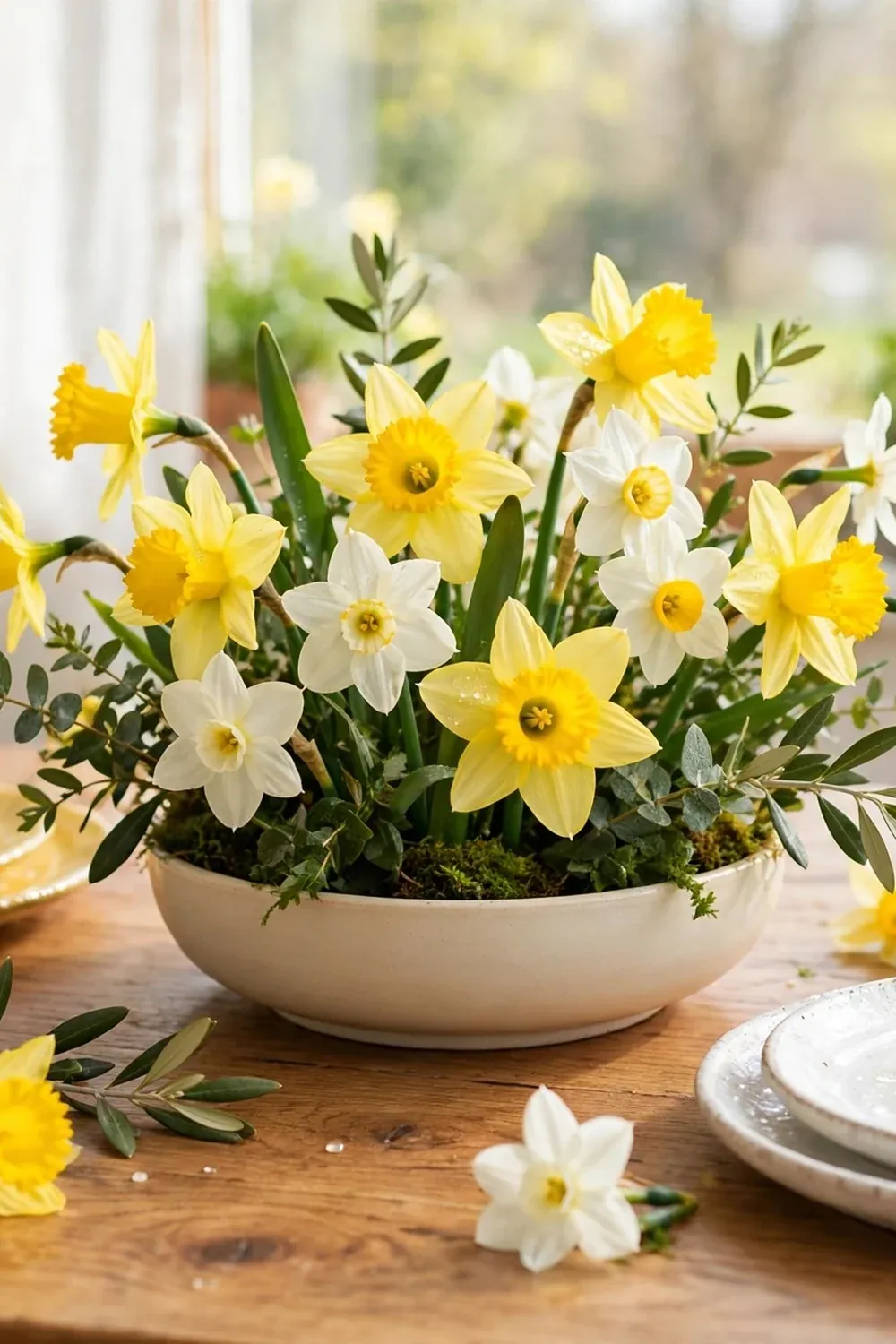
Daffodils are the happiest flowers I put on a table, and also the cheapest to get right. A low bowl of yellow daffodils, with a few white ones mixed in, wakes up a whole table in a way that nothing else in my house does. Yellow plates would be too much, so I use white plates with a yellow napkin, or a yellow plate with a white napkin, never both yellow at once.
I learned to keep daffodil stems short. Left long, they flop over the edge of a bowl by the next morning, and they look tired instead of cheerful. Cut short, in a wide, low bowl, they stand up and look like they mean it. A few green leaves tucked around them hide the stems and make the bowl look full with fewer flowers.
Tip: Daffodils can be a little messy with sap, so wipe the stems before you put them in the bowl, and keep them away from other flowers in the same water if you want the others to last.
5. Set an Easter Tablescape That Feels Elegant, Not Childish
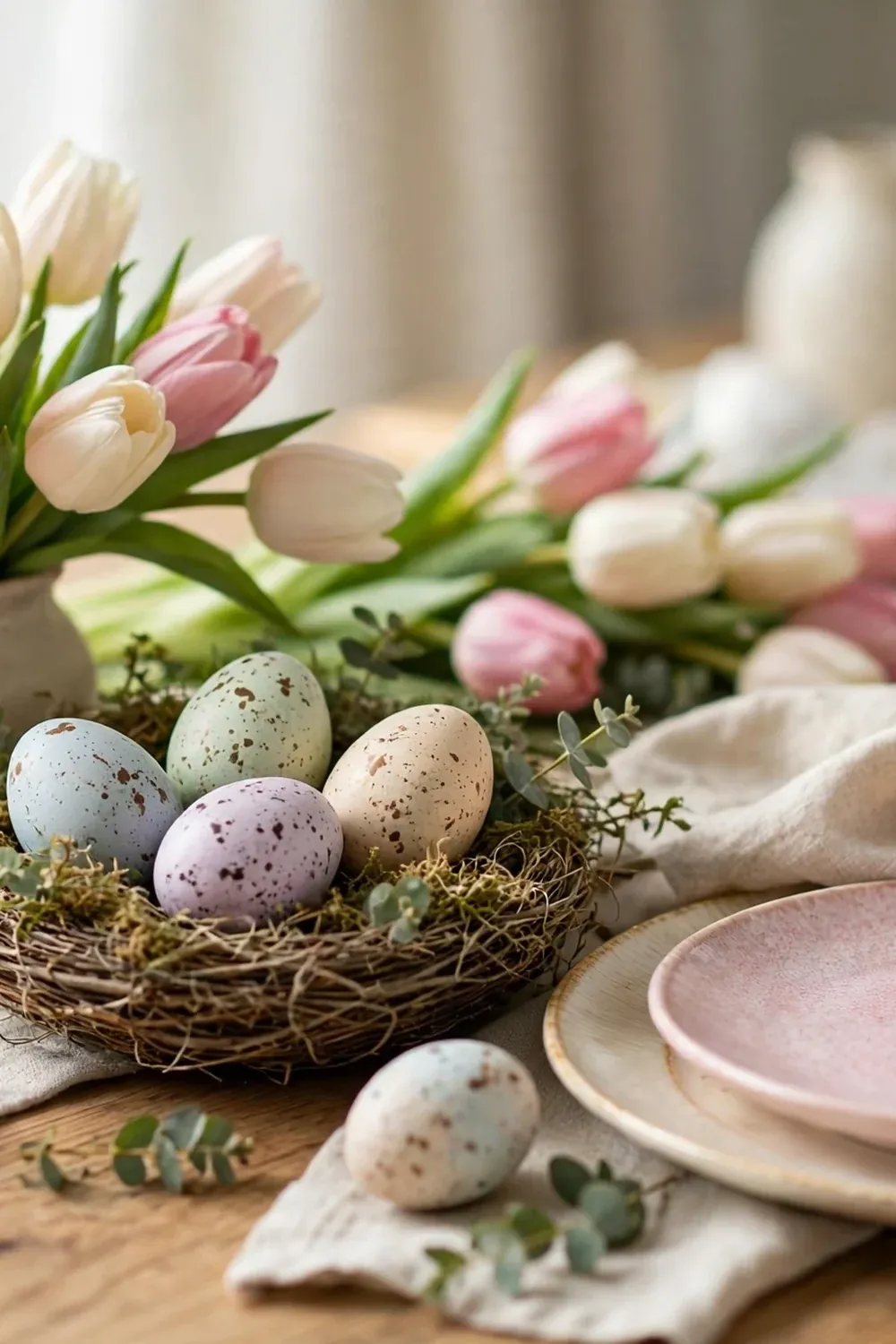
Easter tables can tip into cute very fast, and cute is not what I want for a family meal where adults are also sitting down. My Easter tablescape uses pastel speckled eggs in a small nest bowl as the only openly Easter detail, and everything else is just a pretty spring table. Pink and cream plates, tulips, linen napkins, and that is it. The eggs say Easter, the rest says dinner.
The nest bowl sits a little off center, not right in the middle, because the middle already has tulips. That off-center placement was an accident the first year, when I ran out of room, and I liked it so much I kept it. A table does not need perfect symmetry to look planned. It needs one clear focal point and a few quiet details around it.
For more flower combinations that work at Easter, these Easter flower arrangements have helped me when I only had one bunch to work with.
Tip: Keep Easter decorations to one or two pieces per table. A nest bowl and maybe one small bunny figure, if you love them, is plenty. Five Easter pieces on one table looks like a shop display.
6. Build a Brunch Tablescape Around Food People Can Reach
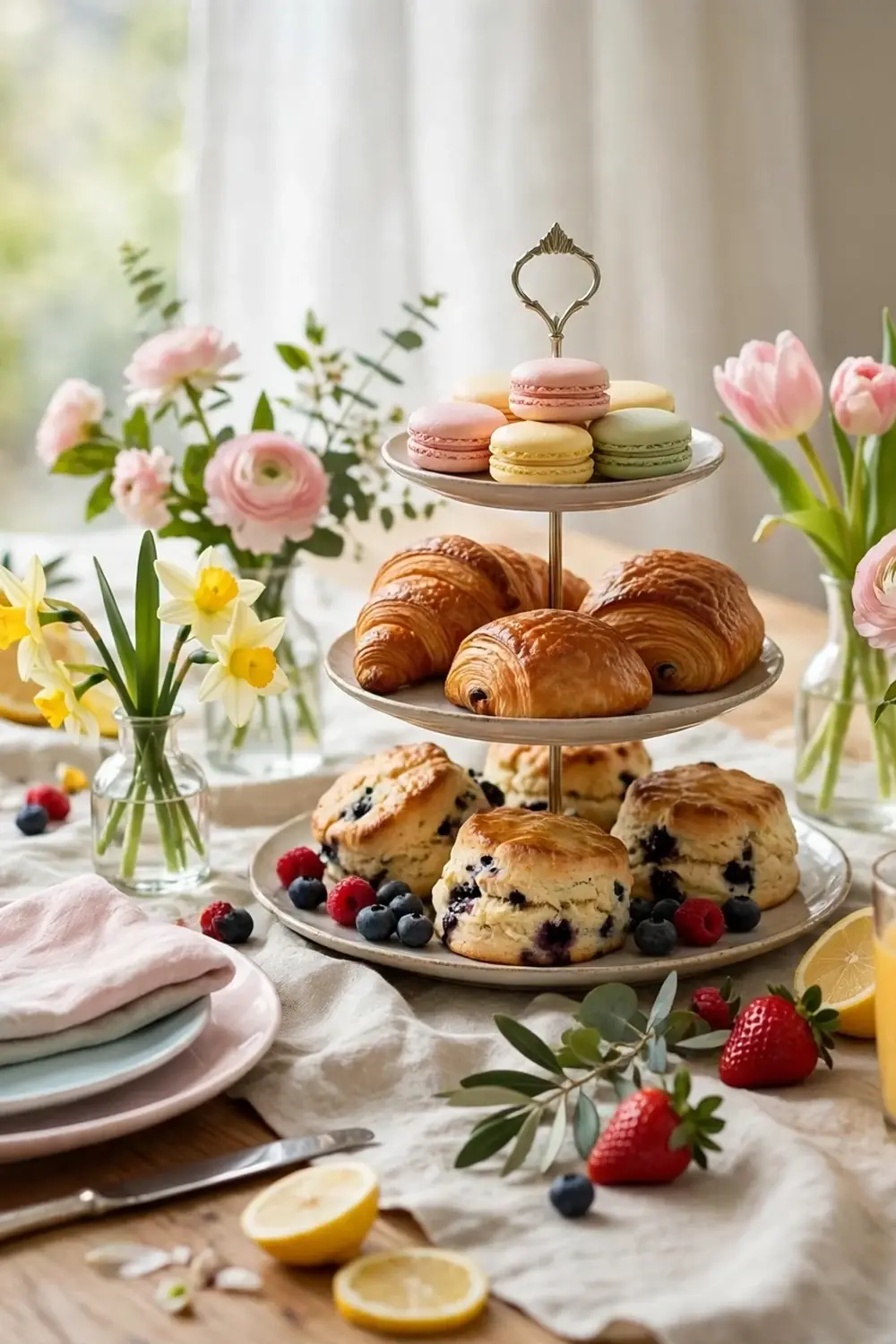
Brunch tables are different from dinner tables, because the food is part of the decoration. I put a tiered stand of pastries in the middle, with small vases of flowers tucked around it, and I set pastel plates at each place with a glass for juice. The stand does double duty, it holds breakfast and it holds the eye, so I do not need a big flower arrangement on top of it.
The mistake I made the first time was putting the stand too close to one end, so the person at that end had pastries in their face and everyone else had to reach. Center it, leave a handspan of space around it, and put the flowers in small vases at the gaps, not in one big bunch. People can pass the stand, see each other, and actually eat, which is the point of brunch.
Tip: Put the tallest thing, the tiered stand, in the middle, and keep everything else lower than it. A brunch table with three tall things is a brunch table nobody can talk across.
7. Light Candles and Let a Spring Dinner Table Glow
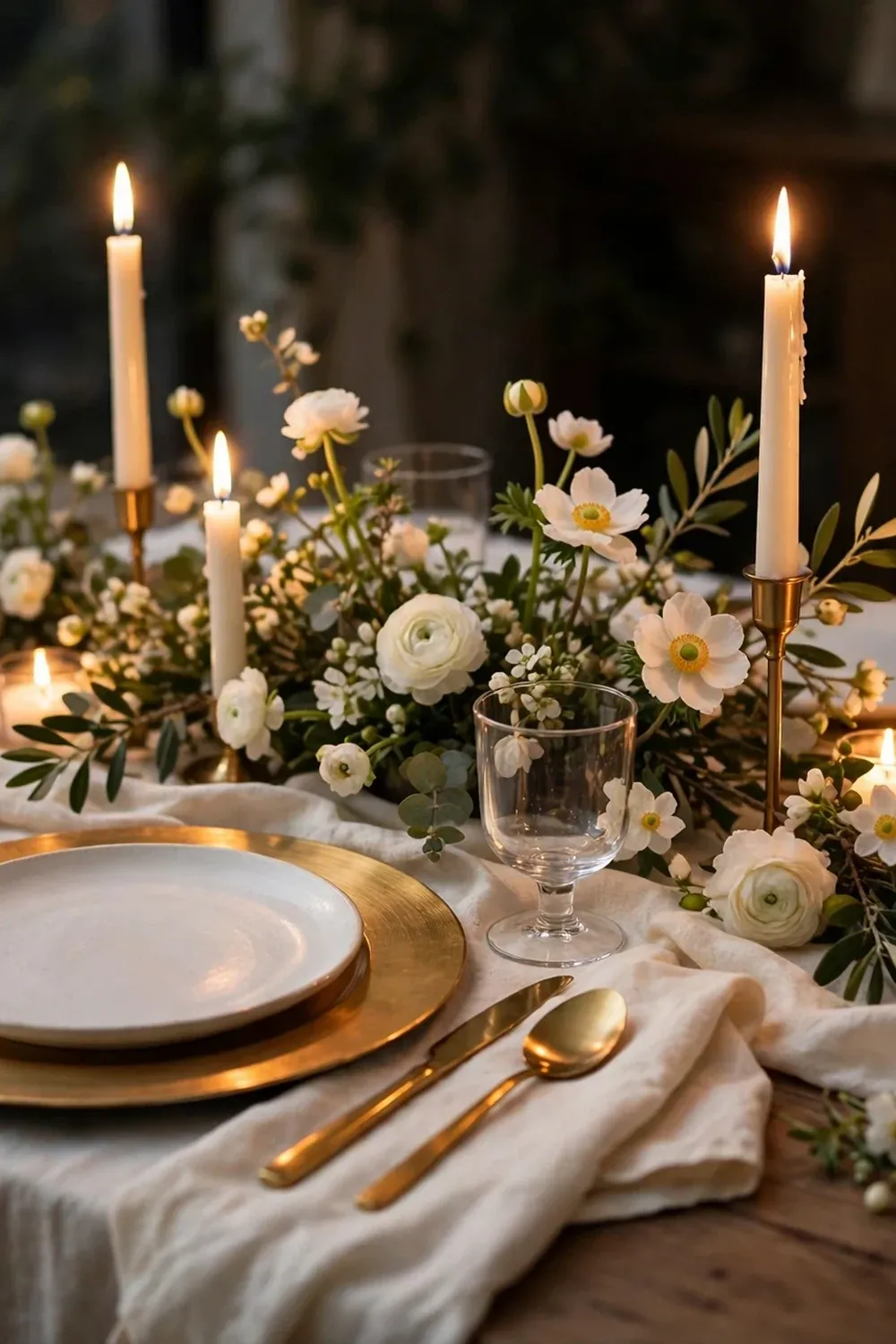
Candles are my favorite shortcut for a dinner tablescape, because they change the whole mood for very little money. I use taper candles in simple holders, spaced down the middle between low white flowers, with gold chargers under cream plates. In daylight the table looks calm and pale. In the evening, with the candles lit, the same table looks like an occasion, and I did not change a single plate.
I once dripped wax on a good cloth, and I have not done it since. A small saucer under each holder, trimmed wicks, and candles blown out before I clear the plates, not after, are my rules now. I also never put a candle right next to a napkin or a paper place card, because a leaning candle and a paper edge are a bad combination, and I would rather be careful than sorry.
Tip: Light the candles last, after the food is ready and everyone is nearly seated. Candles lit an hour early are half burned before dinner starts, and they look tired instead of glowing.
8. Try Blue and White Plates for a Crisp Spring Look
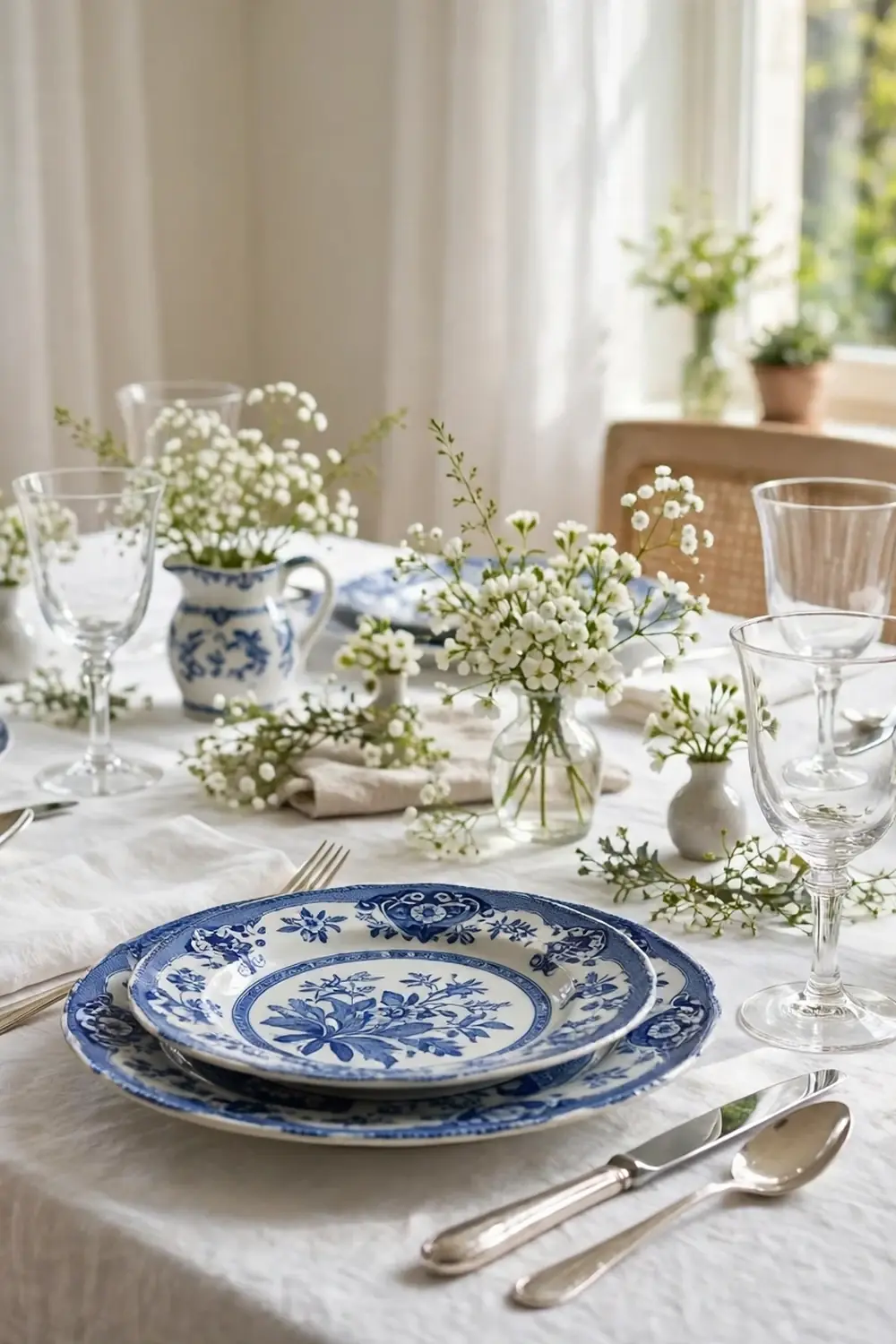
Blue and white is the tablescape I reach for when I want spring without pastels. The plates have a blue pattern, the linen is plain white, the flowers are small and white, and the glasses are clear. It feels crisp, like a clean shirt, and it works in a room that is not already full of color. Pastels can feel soft in a white room. Blue and white feels fresh.
I keep the pattern to the plates only. Blue napkins, blue glasses, and blue flowers on top of blue plates would be too much blue, and the table would lose its calm. One patterned thing, everything else plain, is a rule I come back to again and again, and it has never let me down.
Tip: If your blue plates are busy, use a plain white charger or placemat underneath them. It gives the eye a rest, and the pattern reads as intentional instead of noisy.
9. Keep a Farmhouse Tablescape Relaxed, Not Rough
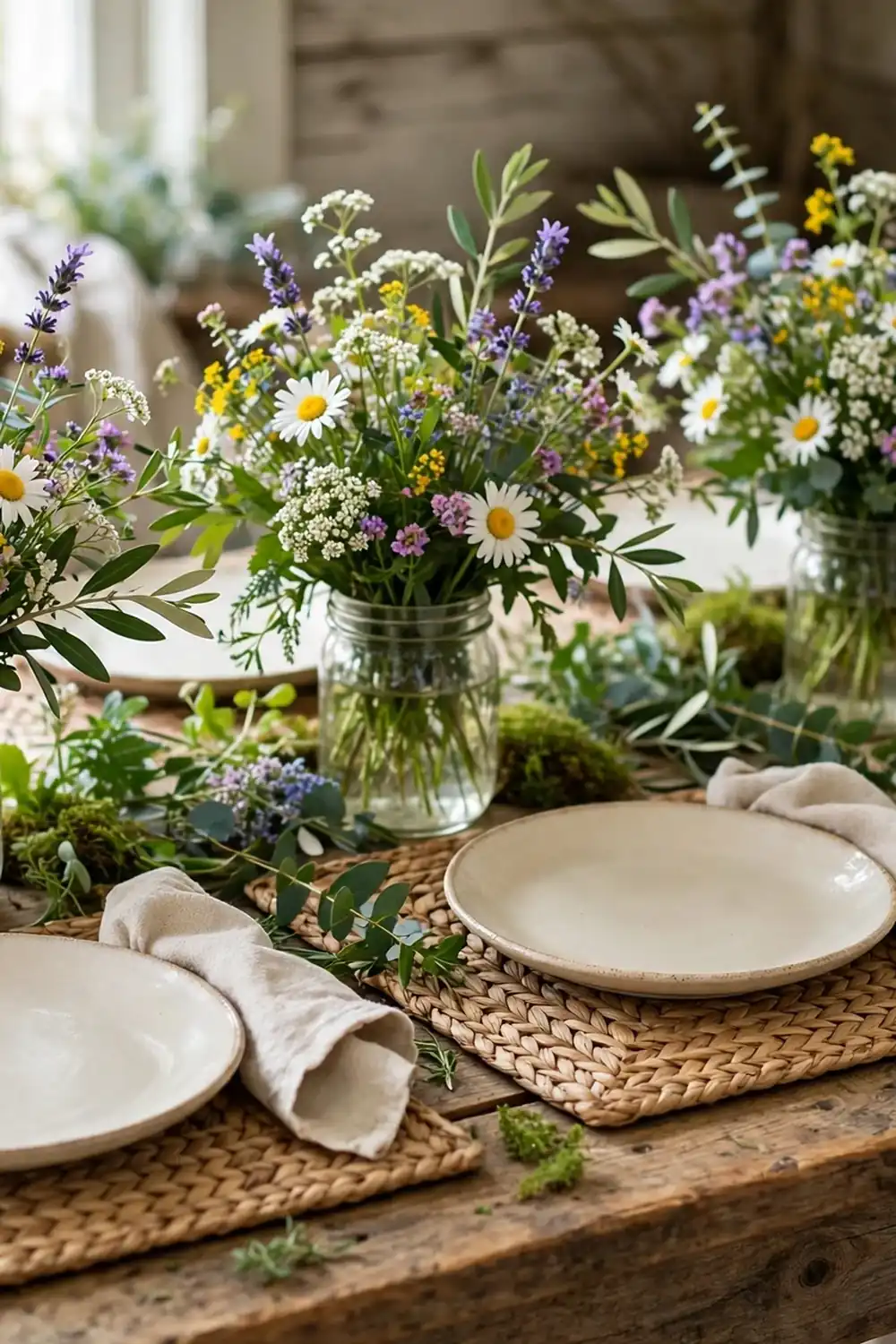
A farmhouse tablescape should feel relaxed, not unfinished, and that line is thinner than it looks. Mine uses a bare wooden table, woven placemats, cream plates, and wildflowers in mason jars down the middle. No tablecloth, because the wood is part of the look, and no fancy glasses, because they would look out of place next to a jar.
The first farmhouse table I set looked a bit bare, because I was afraid of overdoing it. A runner, even a simple linen one, down the middle under the jars fixed that. It gave the jars something to sit on, and it stopped the table from looking like I had just forgotten the cloth. Relaxed means a few things chosen on purpose, not nothing at all.
Tip: Wipe mason jars before you put flowers in them, and trim the wildflower stems so they sit at slightly different heights. Same height looks stiff. Slightly different heights looks gathered, like you picked them yourself.
10. Use Lemons for a Sunny Tablescape That Smells Like Spring
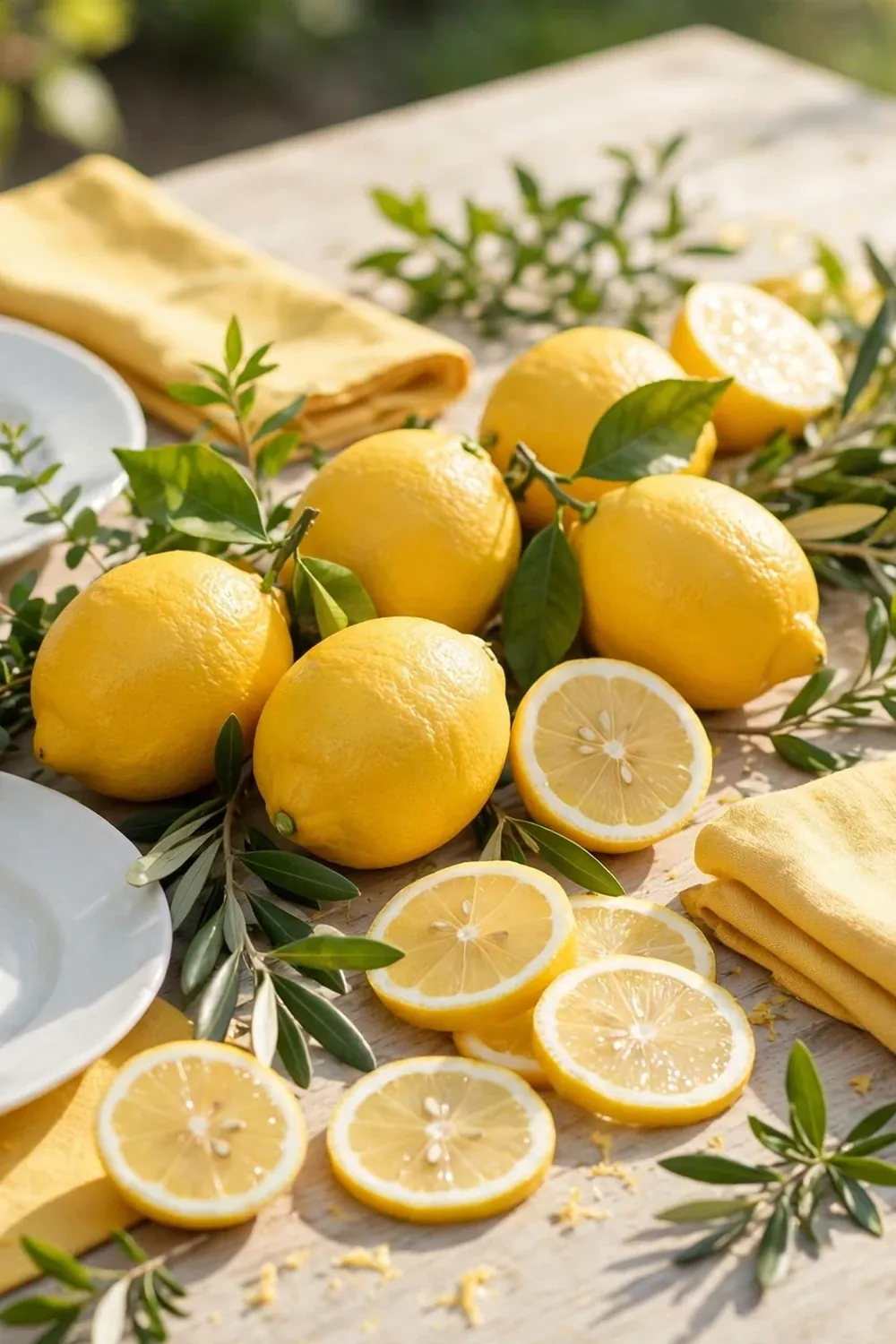
Lemons are the tablescape for days when I do not want to arrange flowers at all. Whole lemons in a low bowl, a few lemon halves tucked around it, yellow napkins, white plates, and green leaves for contrast, and the table looks sunny before anyone sits down. The lemons smell clean and sharp when you lean in, and I can cook with them later in the week, which feels practical, not wasteful.
I put a small mat under the bowl, because a heavy bowl dragged across wood leaves a mark, and I turn the prettiest side of each lemon outward. A dull lemon in the middle of the bowl is the first thing your eye finds, and not in a good way. The rest of the table stays plain, because the yellow is already doing plenty of work.
Tip: Mix whole lemons with a few green leaves, not more fruit. A bowl of only lemons looks like a fruit bowl that wandered in from the kitchen. Leaves make it look like a centerpiece.
11. Put a Small Herb Pot at Each Place and Let Guests Take It Home
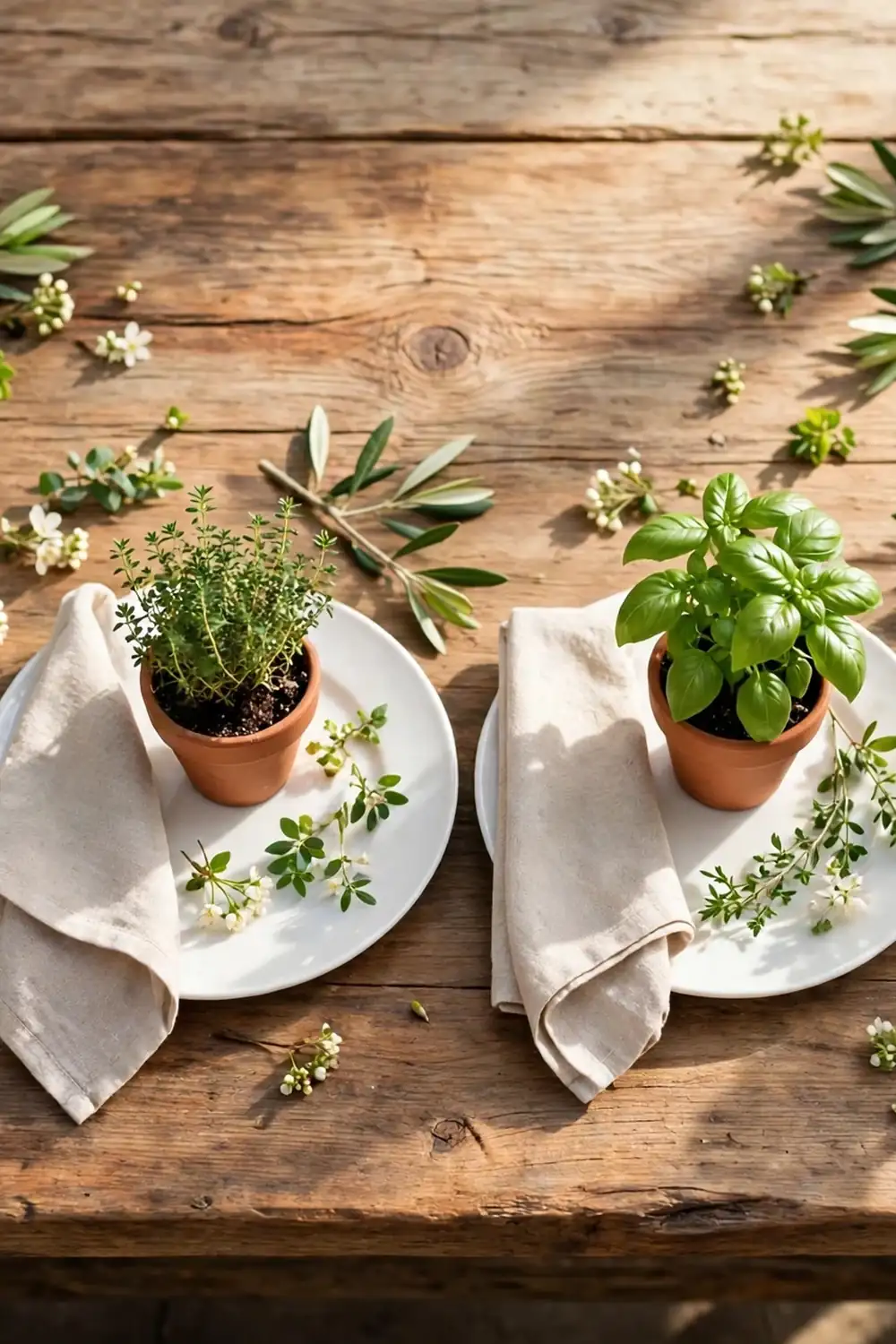
Small herb pots are my favorite place setting detail, because they are a decoration and a small gift at the same time. A tiny terracotta pot of rosemary or thyme sits on each plate, or just above it, and guests can take it home at the end of the meal. It smells wonderful when you sit down, and it makes people feel expected in a way that a plain plate does not.
I water the pots the morning of the meal, not right before guests arrive, so the soil is damp but not wet, and nobody gets mud on a napkin. I also keep the pots small, no bigger than a teacup, because a big pot on a plate leaves nowhere to put the food, and that defeats the purpose. A name card tucked behind the pot, if you use them, turns it into a place card and a favor in one.
Tip: Choose herbs that smell good when brushed, like rosemary or mint, and avoid anything with a strong taste that might put people off before they eat. Rosemary is safe, and it looks good for days after.
12. Make a Blush Peony Tablescape for a Special Spring Evening
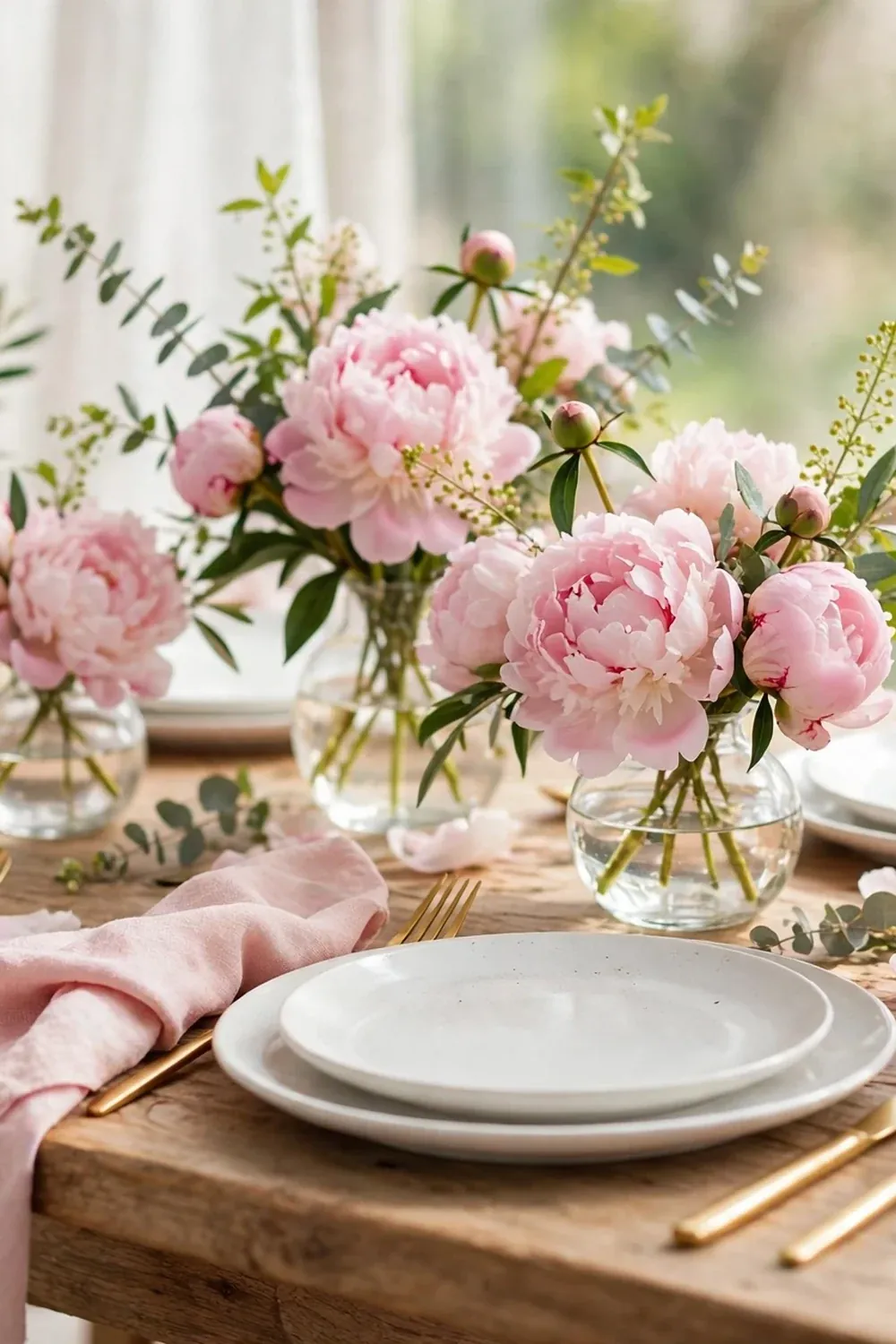
Peonies are a treat, and I treat them like one, which means I do not try to make them do everyday work. A blush peony tablescape, with low peonies in small vases, pink linen napkins, gold cutlery, and white plates, is the table I set when I want the evening to feel special, not just springlike. The peonies are soft, full, and a little extravagant, and the rest of the table stays simple so they can be the star.
Peonies open fast in a warm room, which is both lovely and a little stressful. I buy them a day early, keep them cool, and put them on the table an hour before guests arrive, so they are open but not dropping petals all over the plates. A few petals on the tablecloth are charming. A pile of petals on a plate is not, and I have learned to check before I sit down.
Tip: Use small vases, not one big one, for peonies. One big vase of peonies looks like a bouquet that belongs somewhere else. Small vases down the table look like a tablescape.
13. Take the Tablescape Outside for a Garden Lunch
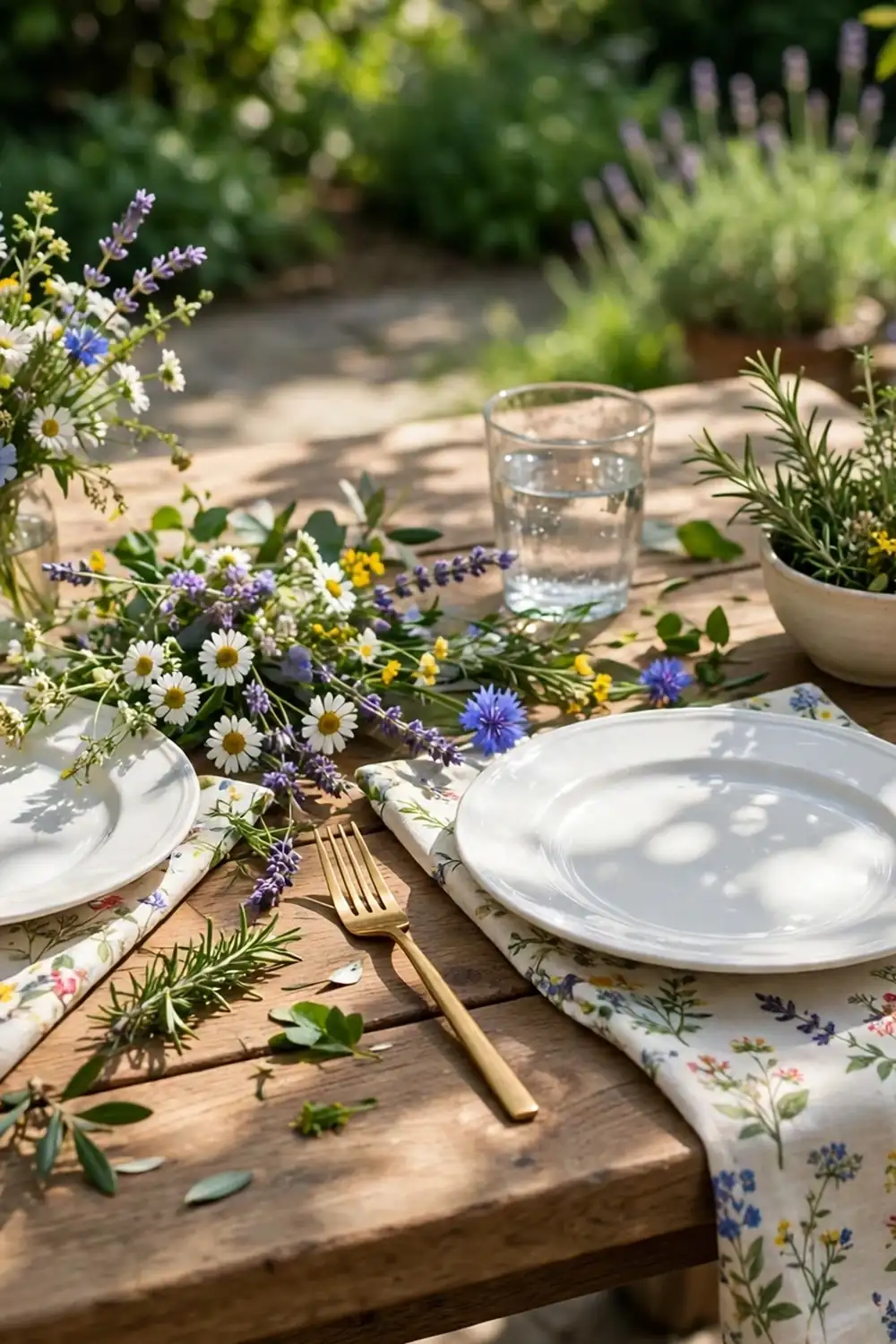
An outdoor tablescape has to survive wind, sun, and the occasional curious bird, and that changes a few choices. I use heavier plates, cloth napkins that will not blow away, and wildflowers in jars with a bit of weight to them, on a patio table in dappled light. Floral napkins, which might be too much indoors, feel just right outside, where there is already green everywhere.
My first outdoor table lost a napkin to a gust of wind, and I chased it across the garden while everyone laughed. Now I fold napkins under the plate edge, or tuck them under a fork, and I use a runner with a bit of weight to it, not a sheer one that lifts at the first breeze. A garden tablescape should feel relaxed, but it should also stay on the table.
Tip: Set the table in the shade if you can, and put drinks in heavier glasses. Sun on white plates is blinding, and light glasses tip over in wind, and both will spoil a lovely lunch faster than anything else.
14. Go Minimal With White and Green When the Room Is Already Busy
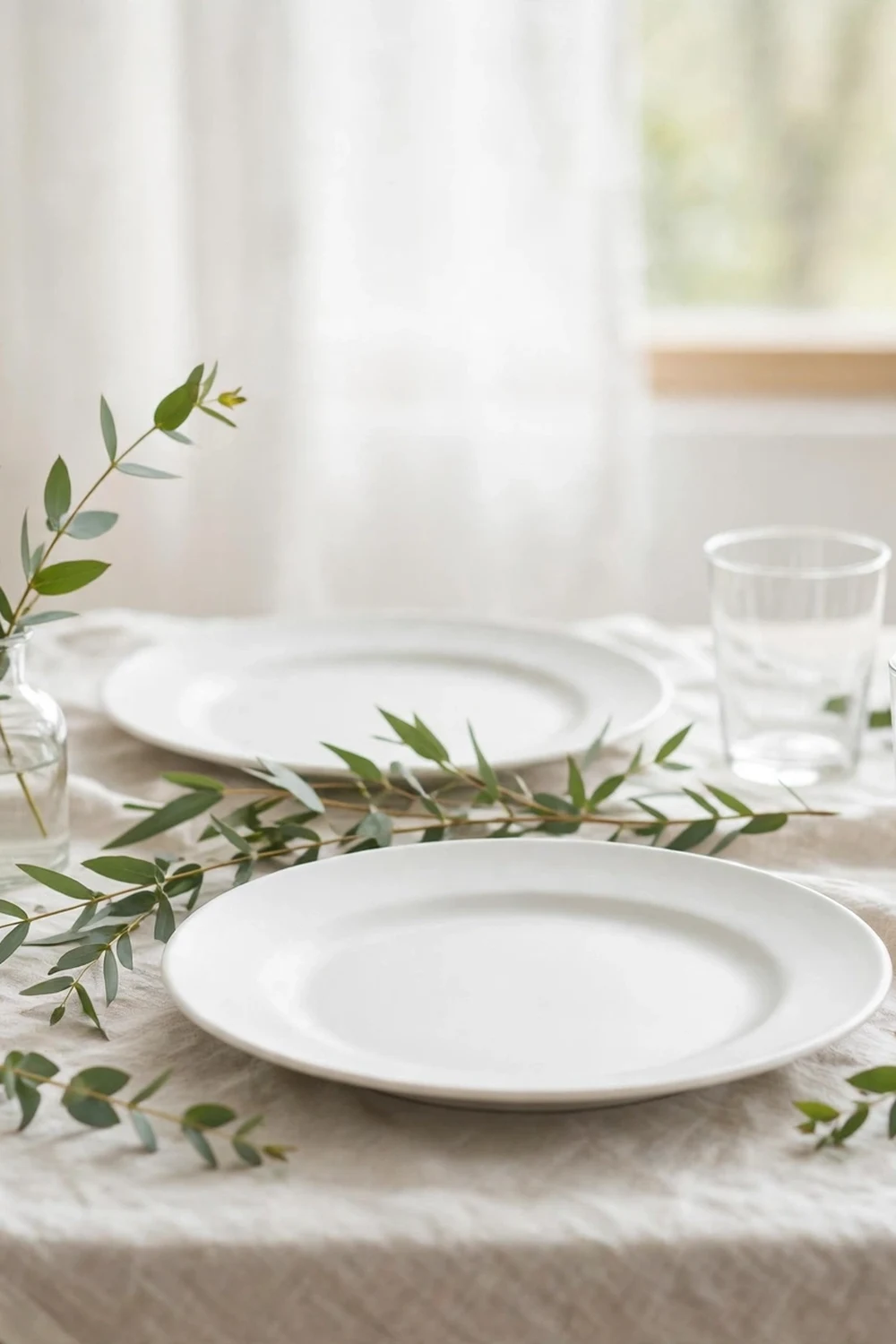
Minimal tablescapes are the hardest to get right, because there is nowhere to hide a mistake. Mine is all white and green, white plates, clear glasses, cream linen, and one eucalyptus sprig at each place, plus a low green runner. It works best in a room that is already busy, with art on the walls or a patterned rug, because the table gives the eye a rest instead of adding more noise.
I used to think minimal meant empty, and my first minimal table looked like I had forgotten half the pieces. A charger under each plate, a proper glass, and a napkin folded neatly, not just tossed down, are what make minimal look intentional. Empty is a table with nothing on it. Minimal is a table with exactly the right things on it, and nothing extra.
Tip: Iron or steam the linen for a minimal table. Wrinkles show more when there is nothing else to look at, and a smooth cloth is half the look.
15. Add Gold Chargers for a Tablescape That Feels Dressed Up
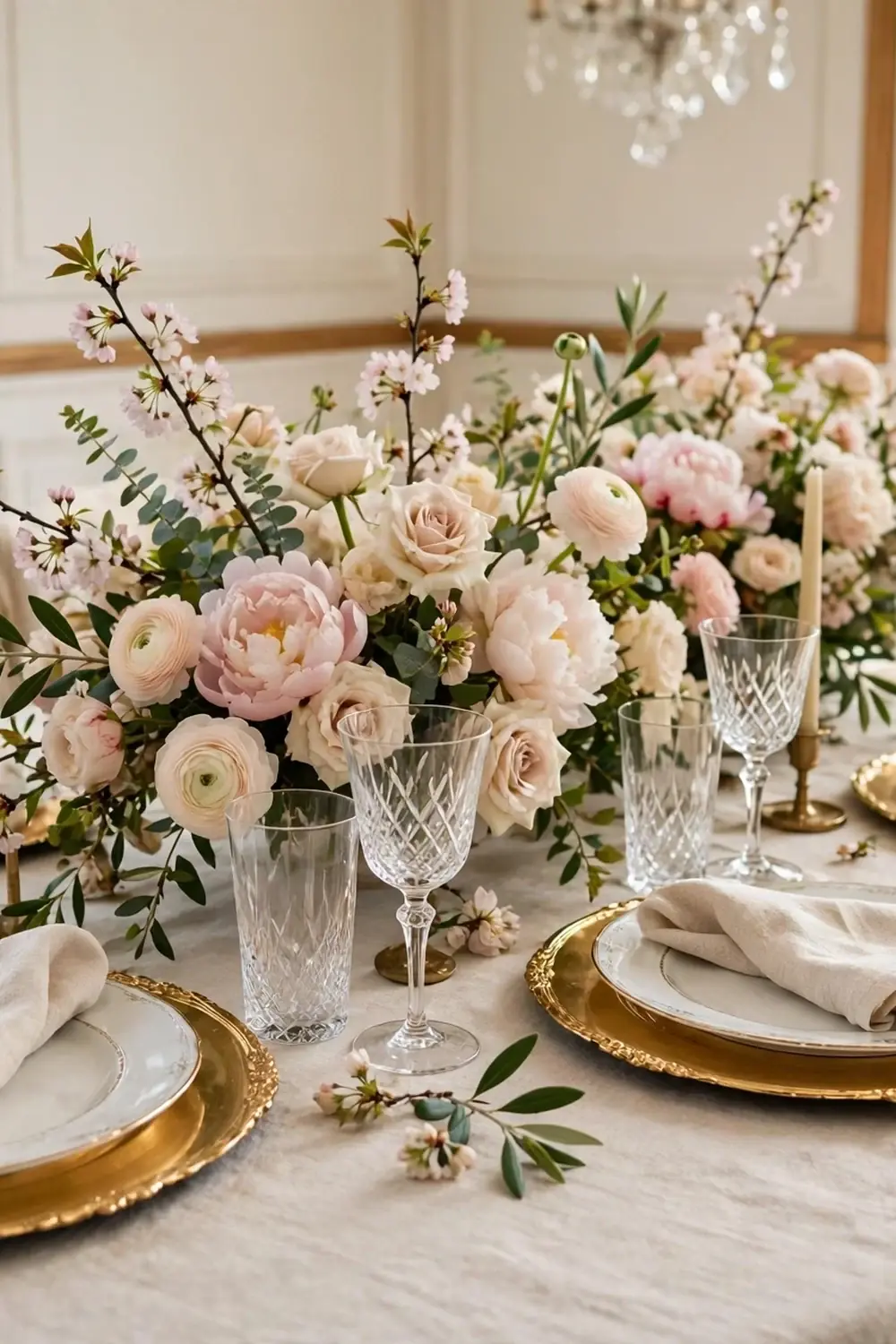
Gold chargers are how I dress up a spring table without buying a new set of plates. A gold charger under a white plate, with cream and blush flowers, crystal glasses, and a folded linen napkin, makes the table feel formal, even if the meal is simple. The gold catches the light, and the flowers keep it from feeling stiff or wintery.
I keep the flowers low and pale when I use gold, because bright flowers and gold together can look loud, like two things competing for the same attention. Cream roses, blush peonies, or white tulips work better than hot pink or orange, and they let the gold be the warm detail, not the only detail.
For a clear reminder of where everything goes at a formal setting, the Better Homes and Gardens guide to setting a table lays out basic, casual, and formal settings in plain language.
Tip: Wipe gold chargers before you set them out. Fingerprints show on gold more than on any other finish, and a smudged charger looks tired before dinner even starts.
16. Use Gingham Napkins for a Cheerful, Casual Tablescape
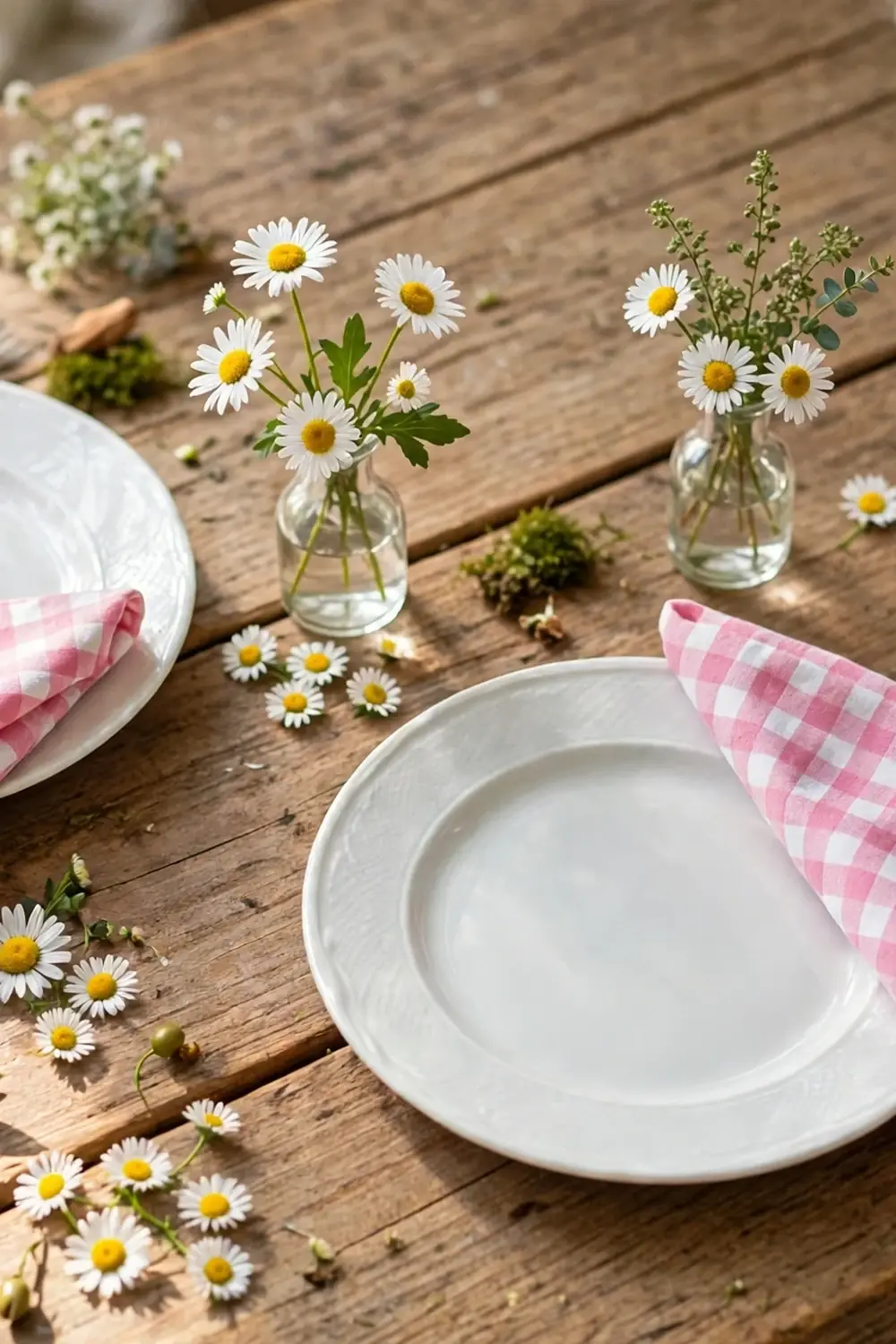
Gingham napkins are pure cheer, and they are the tablescape I use when the meal is casual and the guests are people who will laugh at a joke. Pink gingham napkins, white plates, small daisy flowers, and a wooden table, and the whole table feels like a picnic that moved indoors. It is not elegant, and it is not trying to be. It is happy, and that is enough.
The trick with gingham is to let it be the only pattern. Patterned plates, patterned glasses, and gingham napkins together look like a fabric shop exploded on the table. Plain white plates, clear glasses, and one small flower at each place, and the gingham can be the star without any competition.
Tip: Fold gingham napkins simply, in a rectangle or a loose roll, not in a fancy shape. A fancy fold in a busy check looks fussy, and it will fall apart the first time someone picks it up anyway.
17. Line Up Wildflower Jars for a Relaxed, Gathered Look
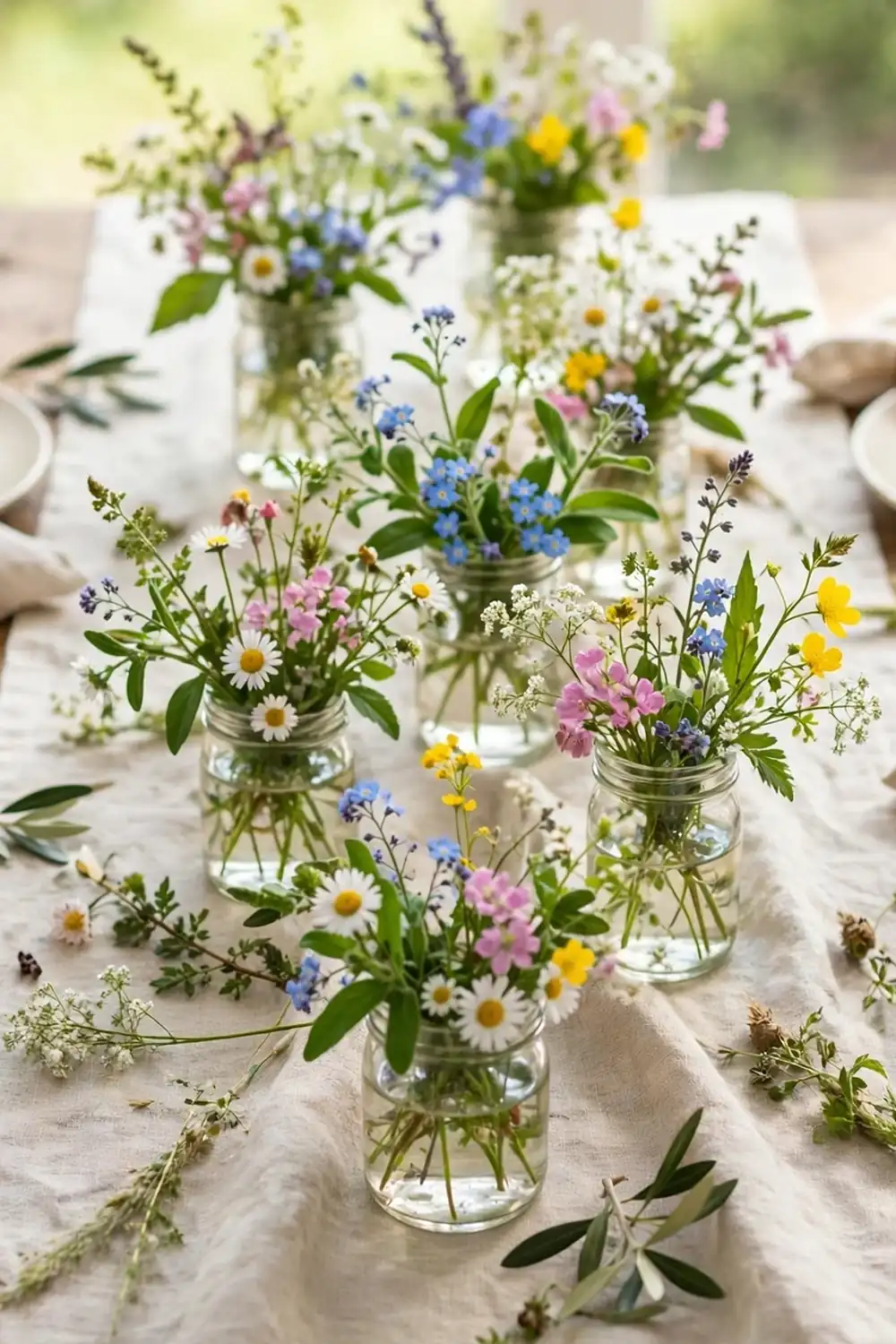
Wildflower jars are the tablescape I set when I want the table to look gathered, not arranged. Small glass jars, each with a few wildflowers, lined down a linen runner, with cream plates and simple cutlery, and the table feels like someone walked outside and came back with flowers, which is more or less what happened. The jars do not match, and that is the point.
I vary the heights a little, a tall jar, a short jar, a medium jar, so the line down the table has a rhythm to it. Same height jars in a row look like a factory line. Different heights look like a garden, and they also let people see each other between the jars, which matters more than perfect symmetry.
If you love this loose, flower-led style, these modern Easter decor ideas use the same soft, gathered feeling in a different part of the house.
Tip: Fill jars only halfway with water, and change it if the flowers will sit out for more than a day. Cloudy water in a clear jar is the first thing people notice, and it is not a good first thing.
18. Let Tall Cherry Blossom Branches Be the Drama
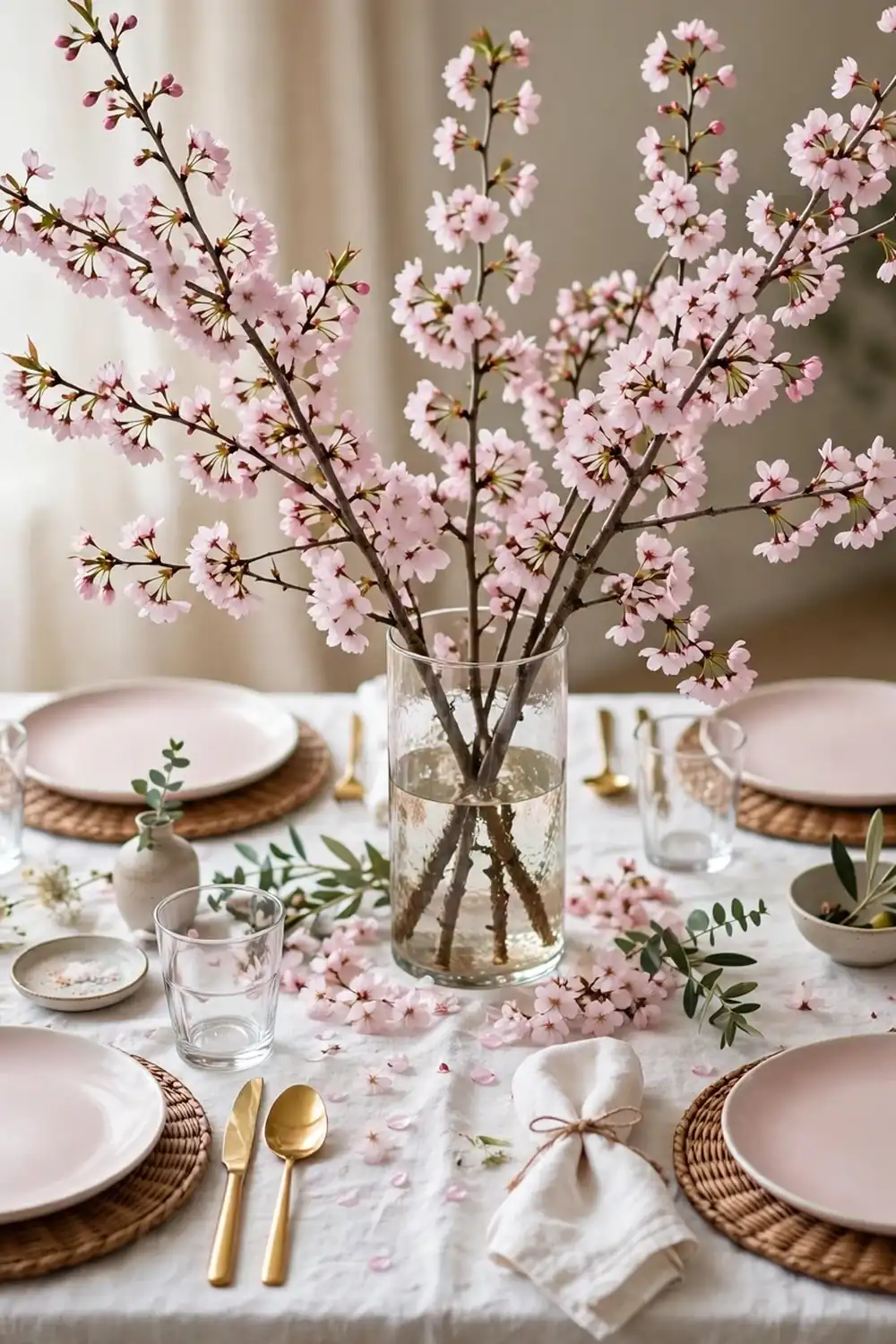
Cherry blossom branches are the one time I break my own low centerpiece rule, and I break it on purpose. Tall branches in a sturdy vase, with pale pink plates, white linen, and a few low flowers at the base, give the table drama without blocking anyone, because branches are airy, not solid. You can see through them, talk through them, and still feel like you are sitting under a tree in bloom.
The vase has to be heavy, because tall branches are top heavy, and a light vase will tip if someone bumps the table. I learned that the hard way, with water on a cloth and branches everywhere, and I have used a heavy ceramic vase ever since. A few low flowers at the base hide the stems and make the tall branches look like they belong on the table, not like they wandered in from the garden.
For a front-of-house spring look to match this table, my spring front porch decor ideas use the same blossom feeling at the door, so the whole house feels like spring, not just one room.
Tip: Keep the branches to one vase, not two or three. One tall vase is drama. Three tall vases is a forest, and nobody can find their plate in a forest.
Frequently Asked Questions About Spring Tablescapes
How do you make a spring tablescape?
Start with one centerpiece, low flowers or greenery, then add plates, napkins, and glasses that share one color with it. Keep the centerpiece low enough to talk across, unless you are using airy branches, and leave a little empty space on the table. A table that is completely covered looks cluttered, not decorated.
What flowers work best for a spring tablescape?
Tulips, daffodils, peonies, cherry blossom branches, and wildflowers all work well, because they are in season and they look like spring. Low vases suit tulips and daffodils best. Peonies suit small vases. Cherry blossom suits one tall, heavy vase. Choose one flower type as the star, and let the rest of the table stay quiet.
How can I make a spring tablescape on a budget?
Use what you already own, white plates, clear glasses, and a plain cloth, and spend on one thing only, usually flowers or a runner. Greenery, lemons, herb pots, and wildflower jars are all low cost centerpieces that look planned. Borrow chargers or candle holders if you can, and keep decorations to one or two pieces per table.
How tall should a spring tablescape centerpiece be?
Low enough that you can see the person across the table without leaning, usually under twelve inches, is a safe rule for most meals. Tall, airy branches are the exception, because you can see through them. If you have to lean to talk, the centerpiece is too tall, no matter how pretty it is.
A spring tablescape does not need to be perfect, and mine never are. A napkin is always a little crooked, a candle always leans a touch, and a flower always droops by the end of the night. That is not a failed tablescape. That is a table that was actually used, by real people, for a real meal, and that is the best kind of table there is.
Pick one idea from this list, try it this week, and see how it feels. If it works, keep it. If it does not, change one thing, the flowers, the napkins, the height of the vase, and try it again. Spring tables are meant to be tried, not just looked at, and the table that feels like spring is the one you actually sit at.