

I used to think a bedroom had to be light to feel restful, and I kept my walls pale for years because of it. Then one winter I slept in a room with deep gray walls and one warm lamp, and I slept better than I had in months. That night changed my mind about cozy moody bedroom ideas completely. Darkness, done with care, does not feel heavy. It feels like the room is holding you a little closer.
This list is about that feeling, and about keeping it cozy rather than gloomy. Every idea here is something I have tried, or watched a friend try, in a real bedroom with real laundry and real mornings. Some cost almost nothing, like changing a bulb. Some take a weekend, like painting a wall. You can always come back to The Inspire Rooms homepage to browse by room, but start here with the one idea that fixes what bothers you most about your bedroom at night.
1. Paint One Wall Dark and Leave the Rest Alone
My first dark wall was an accident in the best way. I bought a tin of charcoal paint for a hallway, changed my mind halfway through, and used what was left on the wall behind my bed. That one wall changed the whole room. The bed suddenly had a backdrop, the pillows looked softer against it, and the room felt smaller in a good way, like a tent rather than a hall.
You do not need to paint the whole room to get this effect, and I would not start there. Paint the wall behind the bed first, live with it for a week, and notice how you feel when you wake up and when you go to sleep. If the wall feels too dark in the morning, add a light picture or a pale throw, and the balance usually fixes itself. The mistake I made was painting a second wall too fast, before I had lived with the first one, and the room went from cozy to cave in one weekend.
Tip: Test the paint on a large board first and move it around the room through the day. A color that looks perfect at noon can look almost black at night.
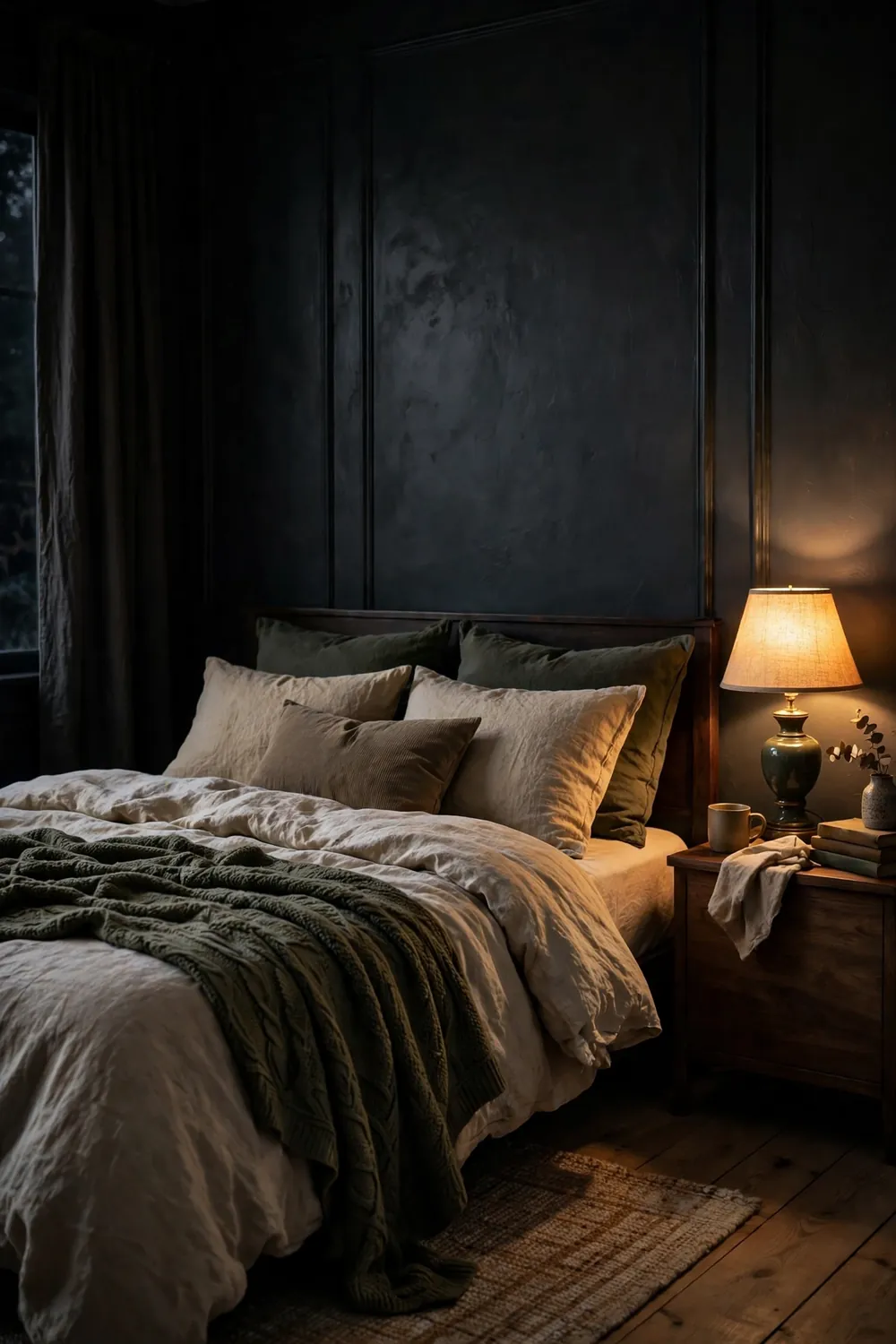
2. Layer Bedding Until the Bed Looks Inviting
A moody bedroom lives or dies by its bed, and mine was flat and boring for a long time. I had a duvet and two pillows, and that was it. Then I added a thin blanket under the duvet, a folded throw across the foot, and two extra cushions I already owned, and the bed looked like somewhere I actually wanted to climb into. Nothing was new except the way I put it together.
Layering works because it gives your hands something soft to reach for. A cool cotton sheet, a warm duvet, and a heavier throw on top mean you can adjust through the night without getting up. I keep the top throw within reach on cold nights, and I push it aside when the room warms up, and that small choice makes the bed feel made for me rather than made for a photo. For more bedroom layering, these spring bedroom ideas show the same soft layers in a lighter room, and the habit transfers well to a dark one.
Tip: Make the bed in layers every morning, even loosely. A bed that looks layered in the morning feels inviting all day, not just at bedtime.

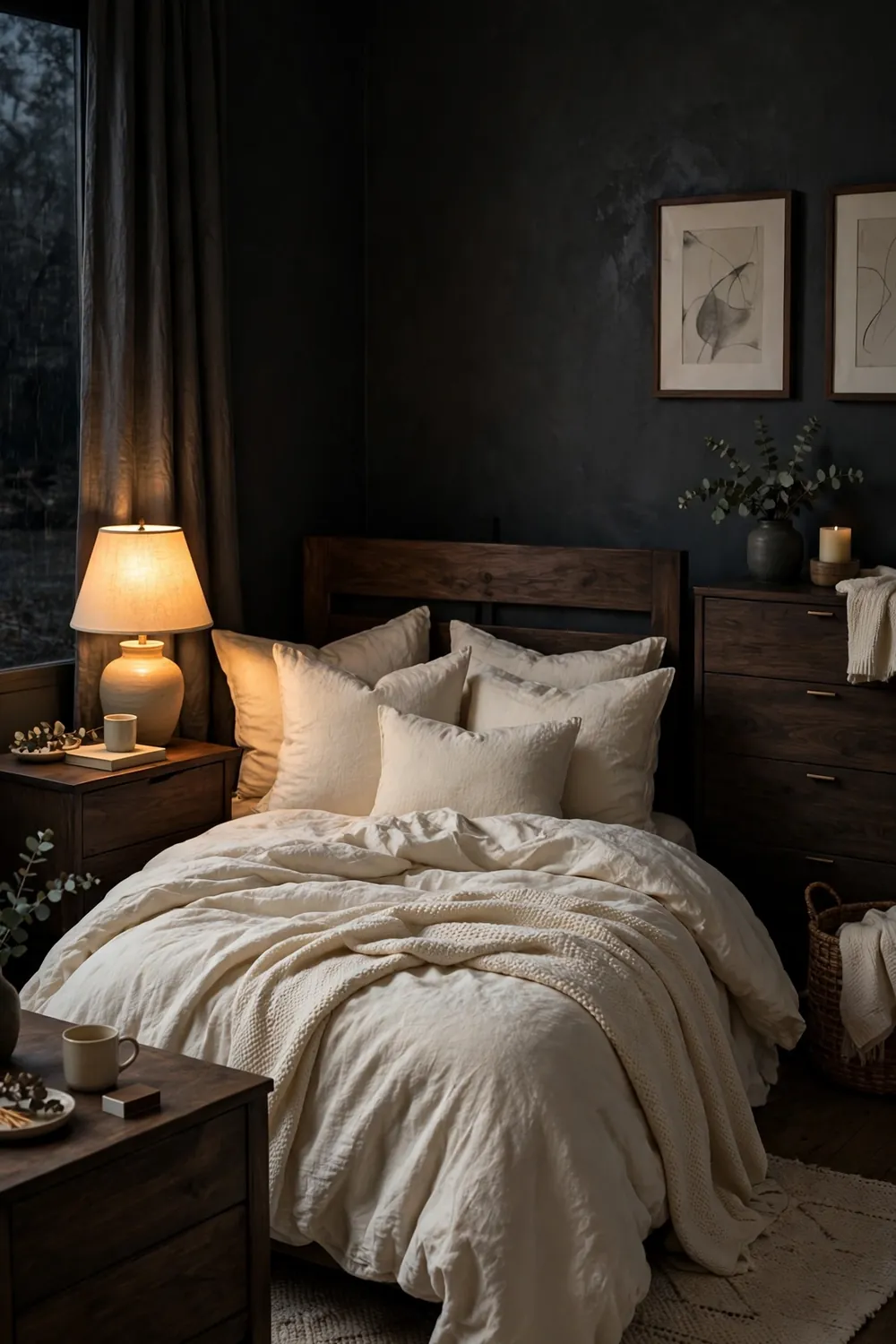
3. Pair Charcoal Walls With Cream Bedding
Charcoal and cream is the pairing I come back to whenever a dark room starts to feel too much. The charcoal gives the room its mood, and the cream bedding keeps it from going flat. I tried an all dark bed once, with dark sheets and a dark throw, and the bed disappeared into the wall. Cream sheets fixed it in one change, because the bed became the lightest thing in the room again.
This pairing is forgiving, which is why I like it for a first moody room. Cream does not fight with charcoal the way a bright color can, and it works with wood, brass, and plants without any extra thought. I keep my cream bedding plain, no pattern, because the wall already gives the room enough depth. A patterned duvet on a dark wall can look busy fast, and I learned that by buying one and taking it back within the week.
Tip: Keep one cream piece in the room even if you love dark colors. A cream pillowcase or a cream throw is enough to stop the room from feeling closed in.
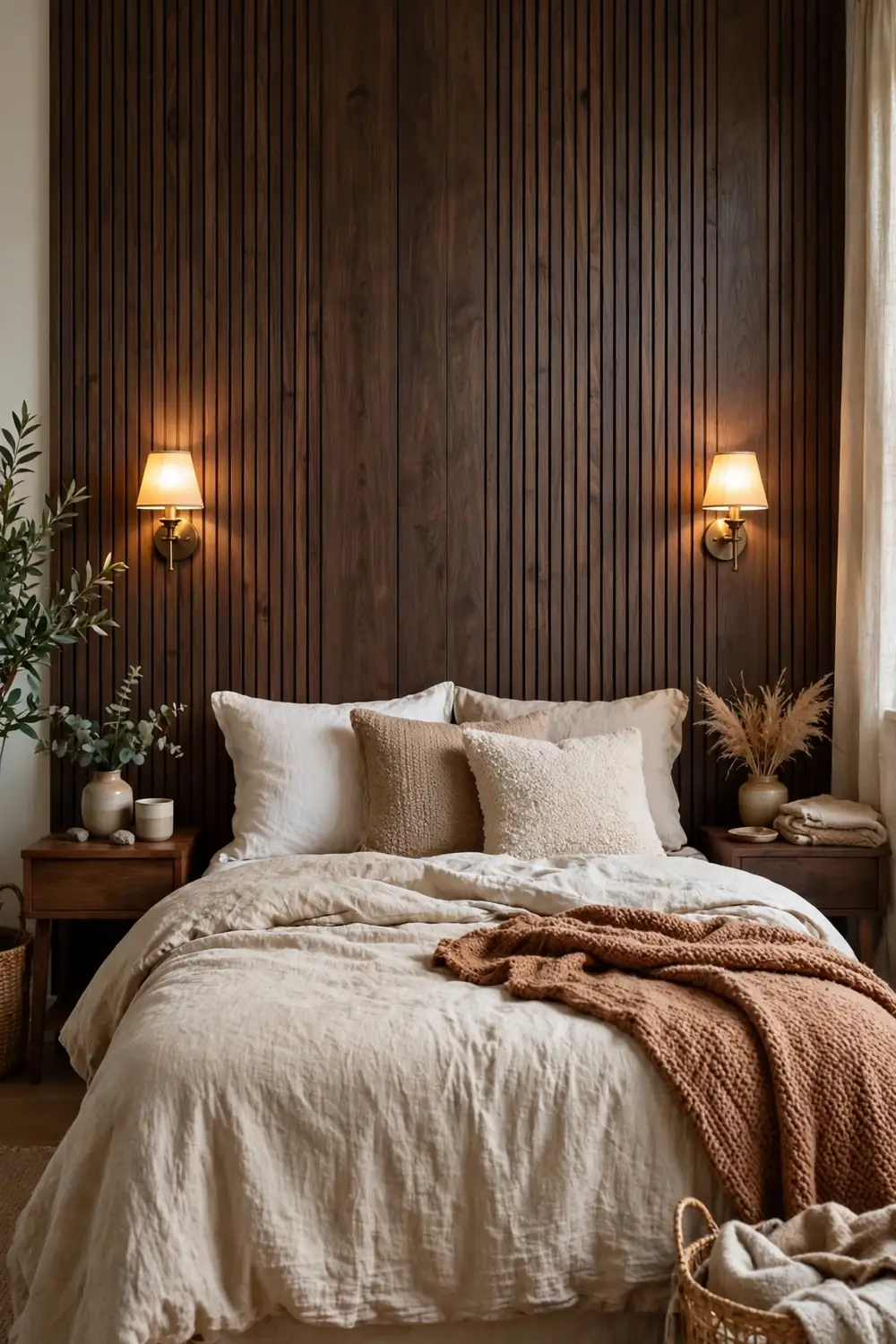
4. Add a Wood Panel Wall Behind the Bed
A painted wall can feel flat, and that was my problem after my first charcoal wall. The color was right, but the wall had no texture, so the room felt like a box. A simple wood panel wall fixed it. I used plain vertical boards, painted them the same dark color as the wall, and suddenly the wall had shadows and lines that changed through the day.
Wood panels also make a headboard feel less necessary, which helped my budget. The bed sits against the panels, the panels do the visual work, and I did not need to buy a tall headboard at all. If you rent, or you do not want to commit, try a freestanding panel or a large wooden board behind the bed first. I lived with a leaning board for a month before I fixed panels to the wall, and that test told me the idea was worth the effort.
Tip: Paint the panels the same color as the wall, not a contrasting one. Matching paint keeps the texture subtle, and contrasting paint can make the wall shout.
5. Turn Off the Ceiling Light and Use Lamps Only
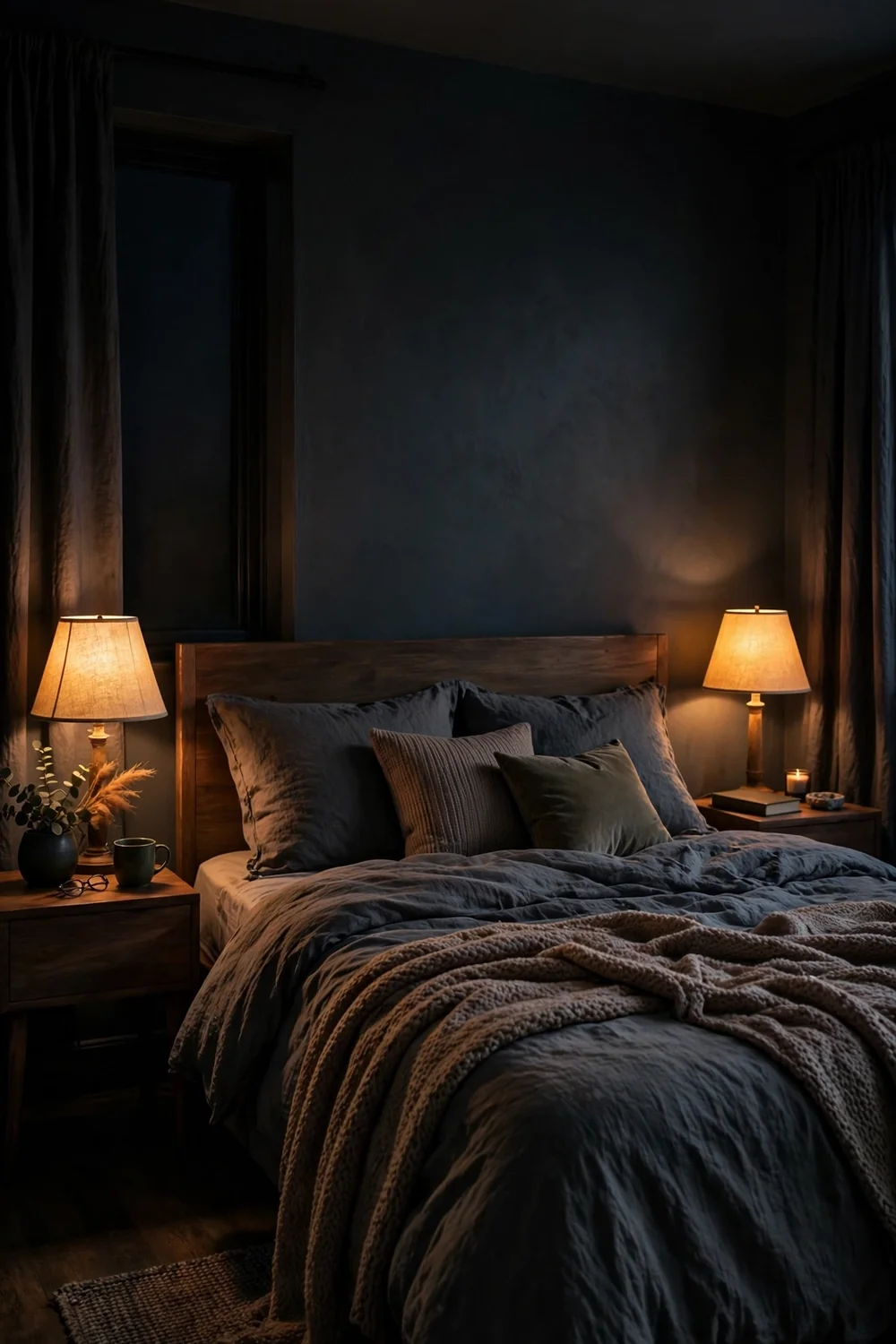
The single biggest change in my bedroom cost me nothing. I stopped using the ceiling light in the evening and switched to two bedside lamps instead. The ceiling light had made the dark walls look harsh, because it threw light straight down and left the corners black. Lamps put light at sitting height, where I actually am, and the walls glow instead of glaring.
Warm bulbs matter here more than lamp style. I use warm white bulbs, the kind that look a little golden, because a cool white bulb can turn a charcoal wall blue and cold. I also keep the lamps at the same height on both sides of the bed, because uneven lamps make the room feel lopsided in a way I notice every night. Dimmer switches help, and I put one on the lamp I use for reading, so I can turn it down without getting up.
Tip: Try one evening with only lamps on before you buy anything new. If the room already feels better, you have your answer, and it cost nothing.
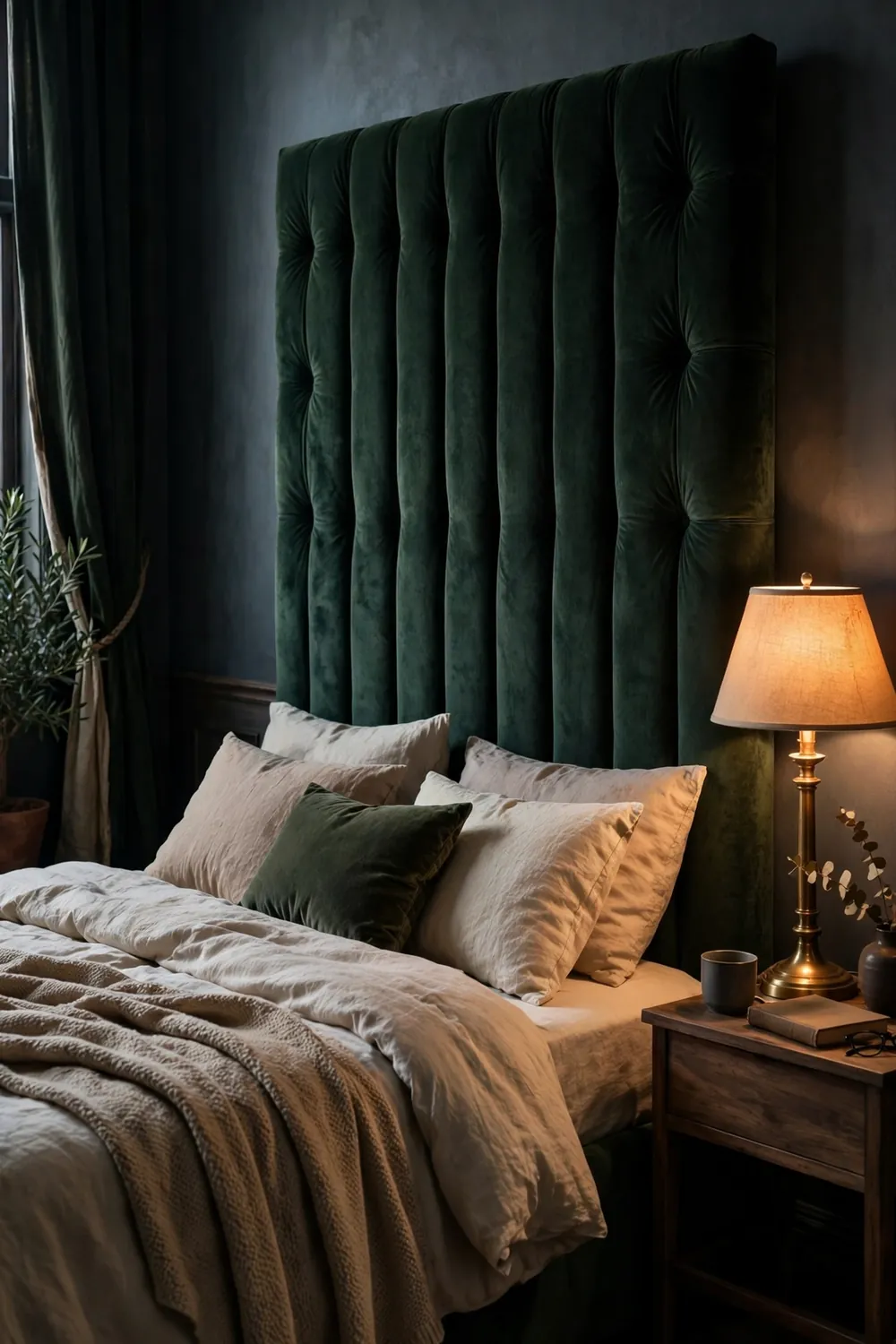
6. Choose a Velvet Headboard in a Deep Color
Velvet sounds fancy, and I avoided it for years because I thought it would be hard to look after. Then I bought a secondhand velvet headboard in a deep green, and it turned out to be the most forgiving piece in the room. Dust brushes off, marks do not show the way they do on pale fabric, and the texture catches lamplight in a way flat fabric never does.
A velvet headboard also softens a dark room in a way wood cannot. When I lean back to read, the headboard is warm and soft behind me, and that small comfort is what makes the room feel cozy rather than just dark. I keep the rest of the bedding plain when the headboard is velvet, because two strong textures in one bed can fight each other. One soft statement piece, and plain layers around it, is the balance that has worked in my room.
Tip: Sit against a velvet headboard in a shop before you buy one, if you can. Some velvets feel plush and some feel scratchy, and you will lean on it every night.
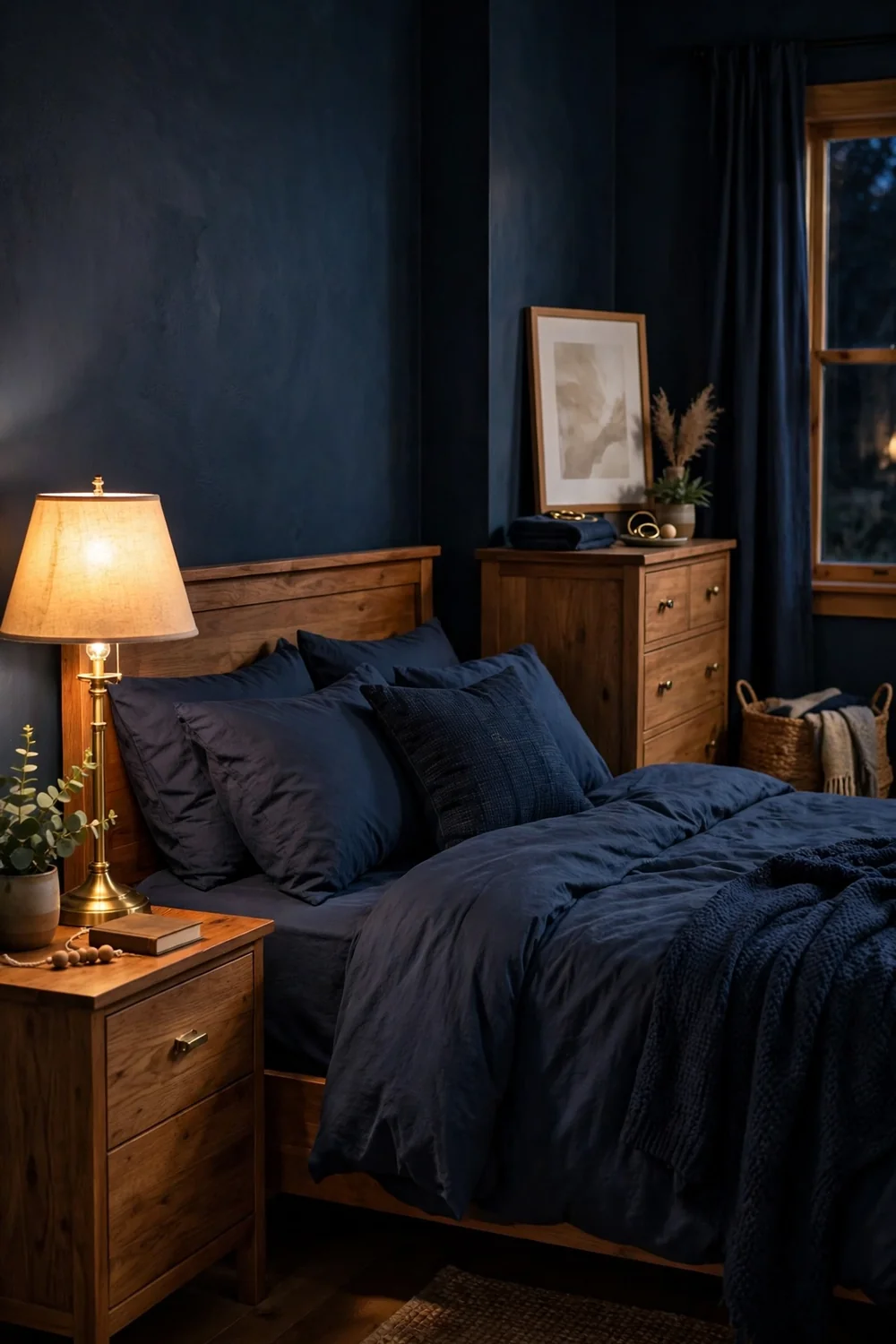
7. Try Deep Navy Instead of Black
Black walls scare most people, and honestly they scared me too. Navy was my way in. It gives the same depth as black, but it feels softer in the morning, especially with wood and brass nearby. My navy corner has a brass lamp and a wooden bedside table, and the combination keeps the room warm even on gray days.
Navy also pairs well with bedding colors I already owned. Cream, rust, and soft gray all sit happily against it, so I did not need to buy a whole new bedding set to make it work. If you are unsure between navy and charcoal, paint a test patch of each on the same wall and look at them at night, not just in daylight. I chose navy because it looked calmer under lamplight, and that is when I spend most time in the room. For more bedroom color ideas in one place, the Homes and Gardens bedroom ideas pages helped me compare dark shades before I committed to a tin.
Tip: Use navy on the wall you see least in the morning if you worry about darkness. The bed wall is a good start, because you face away from it when you wake up.
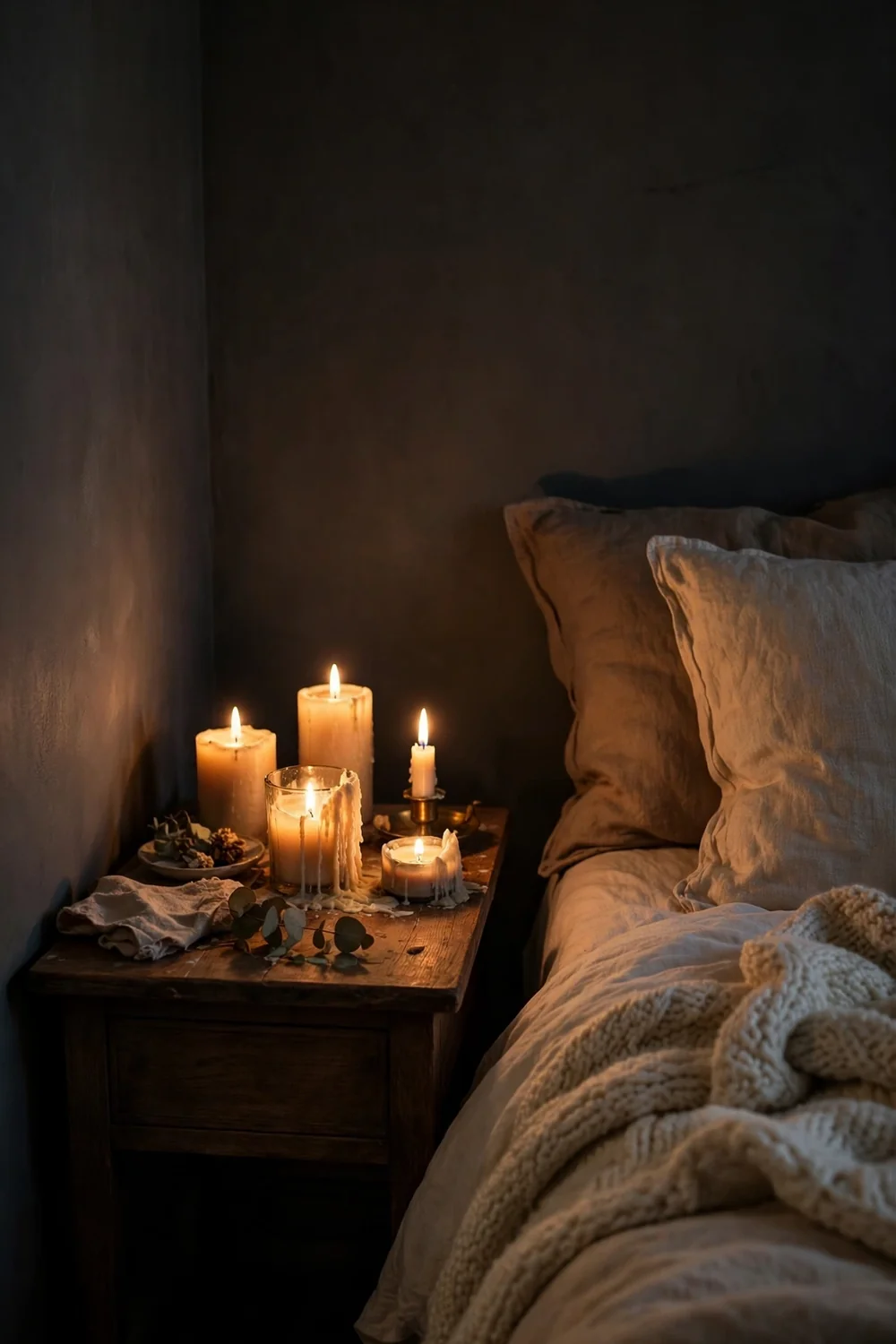
8. Light Candles in One Corner Only
Candles get a bad reputation in bedrooms because people imagine a whole room full of them, and that does feel like a fire risk and a fuss. I use candles in one corner only, on a wooden tray on my bedside table, and I light two at most. The tray catches any wax, the candles stay away from bedding, and the corner glows in a way no lamp quite manages.
I never leave them burning when I leave the room, and I blow them out before I fall asleep, even if I am only nearly asleep. That rule matters, and I keep it even on nights when the room looks lovely with them lit. A candle corner is for the hour before bed, for reading or winding down, not for sleeping through. Used that way, it turns the last hour of the day into a small ritual instead of just screen time.
Tip: Put candles on a tray with a raised edge, away from curtains and bedding. A tray makes the corner feel deliberate, and it keeps wax off the table.
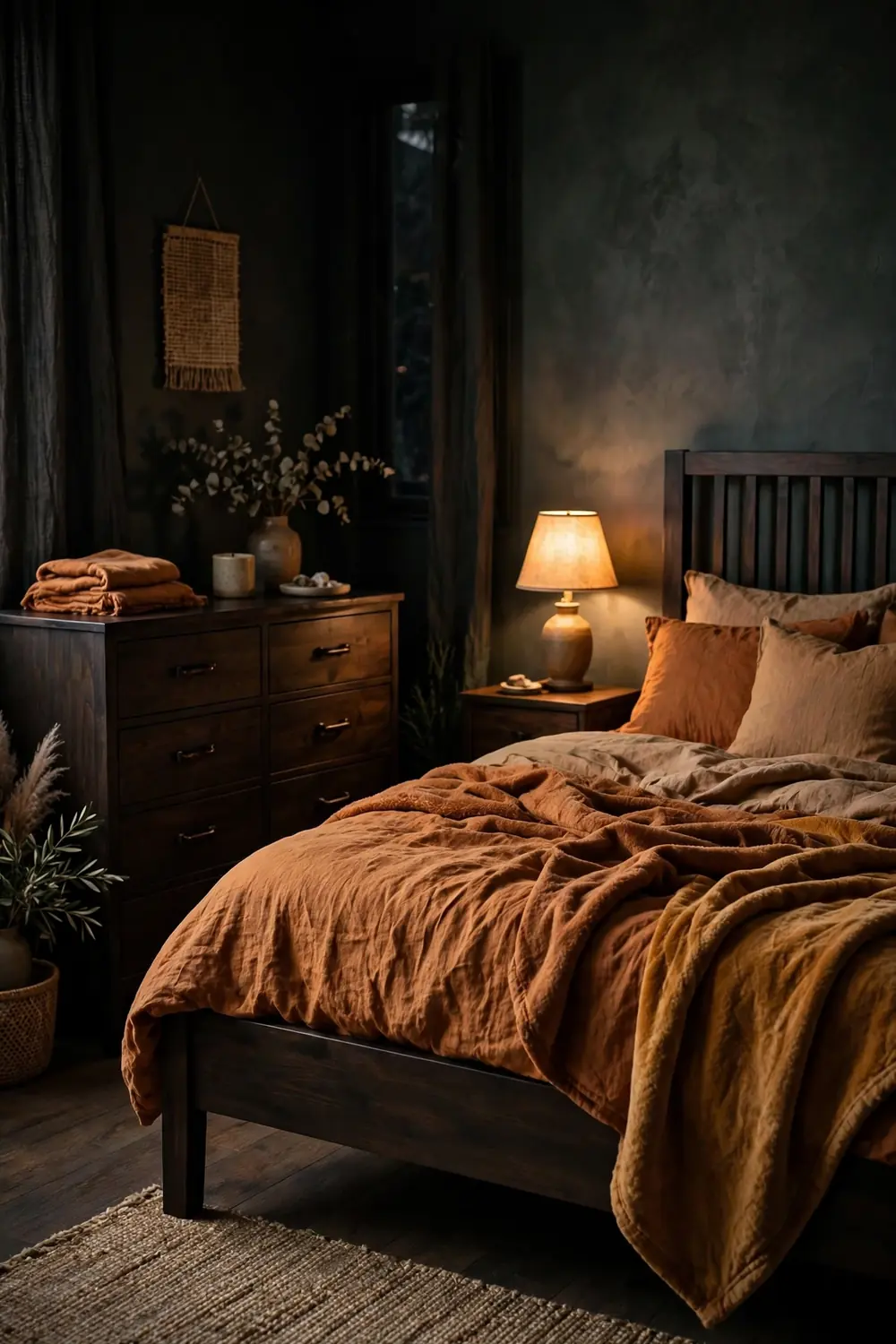
9. Let Dark Wood Do the Moody Work
If painting a wall feels like too much, dark wood can carry the moody feeling on its own. My bed frame and dresser are both dark stained wood, and against pale walls they still make the room feel grounded and warm. The wood grain gives the room texture, and the dark tone stops the pale walls from feeling cold in winter.
Dark wood also ages well in a way painted walls do not. A scratch on a dark wooden dresser can be oiled and mostly disappears, while a scuff on a dark painted wall shows every time the light hits it. I learned this after repainting one wall twice in a year, while the wooden furniture next to it just got better looking. If you already own dark wood pieces, try moving them into the bedroom before you buy paint. You may find the room already has the mood you wanted.
Tip: Mix one dark wood piece with a lighter wood accent, like a pale tray or a light frame. Two dark woods together can look heavy, while a light accent keeps the balance.
10. Pile on Knit Throws, Not Just Cushions
Cushions look good in photos, but throws are what I actually reach for. My bed has two knit throws now, one chunky cream one across the foot and a thinner rust one folded over the arm of a chair. The cushions come off at night and pile on the chair, but the throws stay, because I pull one over me when I read and push it aside when I sleep.
Knit texture matters more than color here, in my experience. A smooth throw on a smooth duvet slides off and looks flat. A chunky knit catches the light, holds its shape, and feels warm the moment you touch it. I wash mine on a gentle cycle and dry them flat, because a shrunken throw is a sad thing, and I lost a good one that way before I learned to read the label.
Tip: Keep throws where you can reach them without standing up. A throw folded on a chair across the room will stay folded, while one at the foot of the bed gets used every night.

11. Layer Curtains for Darkness and Softness
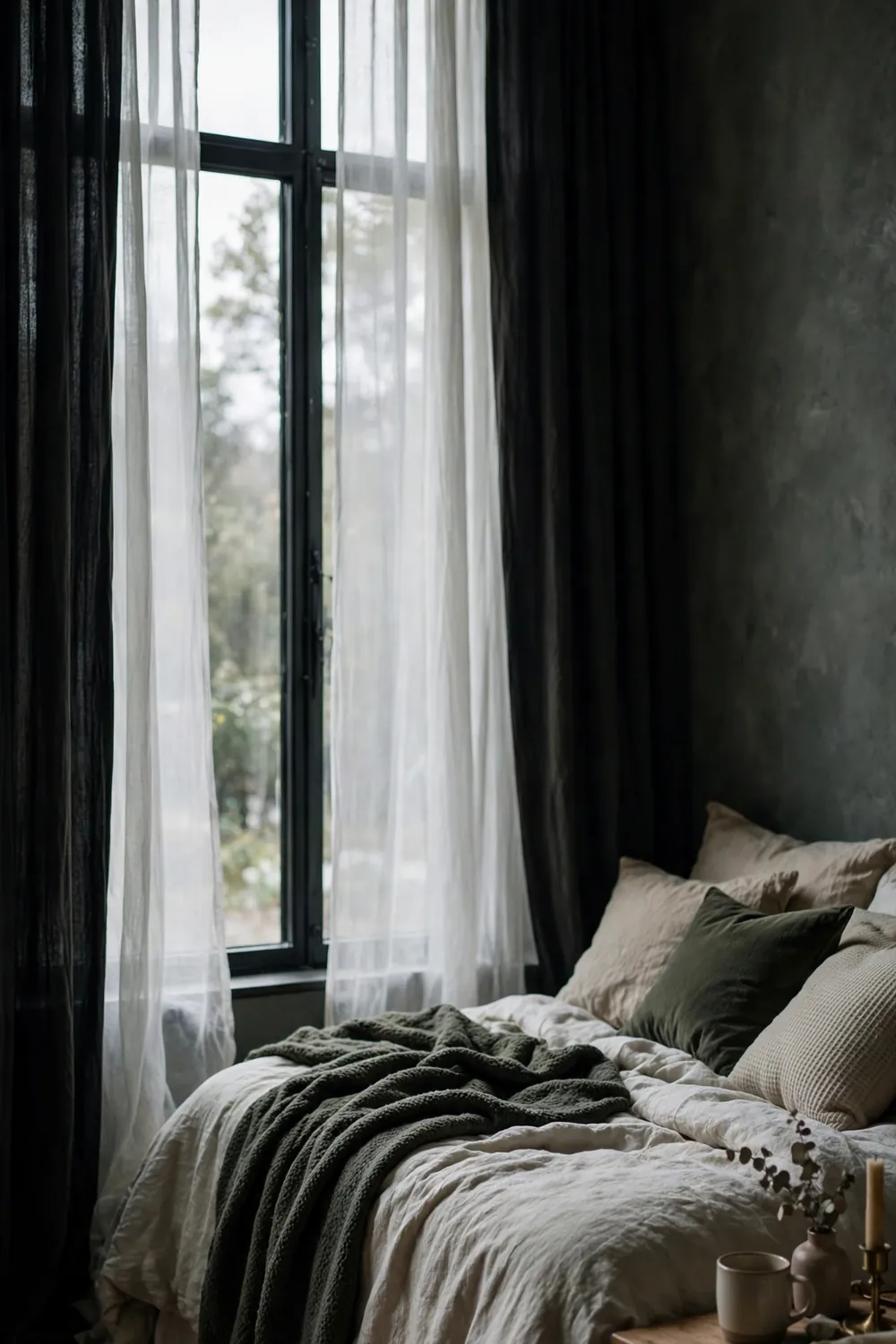
One set of curtains never did both jobs in my bedroom. Sheers alone let in too much streetlight at night, and heavy curtains alone made the room feel shut in during the day. Layering solved it. I hang a sheer curtain closest to the glass for daytime privacy, and a heavier dark curtain over it for night, and I use each one at the time it suits.
The heavy curtain also helps the room feel moody in the best sense. When I draw it at night, the room closes in gently, street noise drops a little, and the lamplight feels warmer because there is no cold glass in view. In the morning I pull the heavy curtain back and leave the sheer up, so daylight comes in soft instead of harsh. This one change made my dark walls look better too, because the window no longer glared against them.
Tip: Hang both curtain layers high and wide, past the window frame. A window that looks larger makes a dark room feel less boxed in.
12. Make a Reading Nook in the Darkest Corner
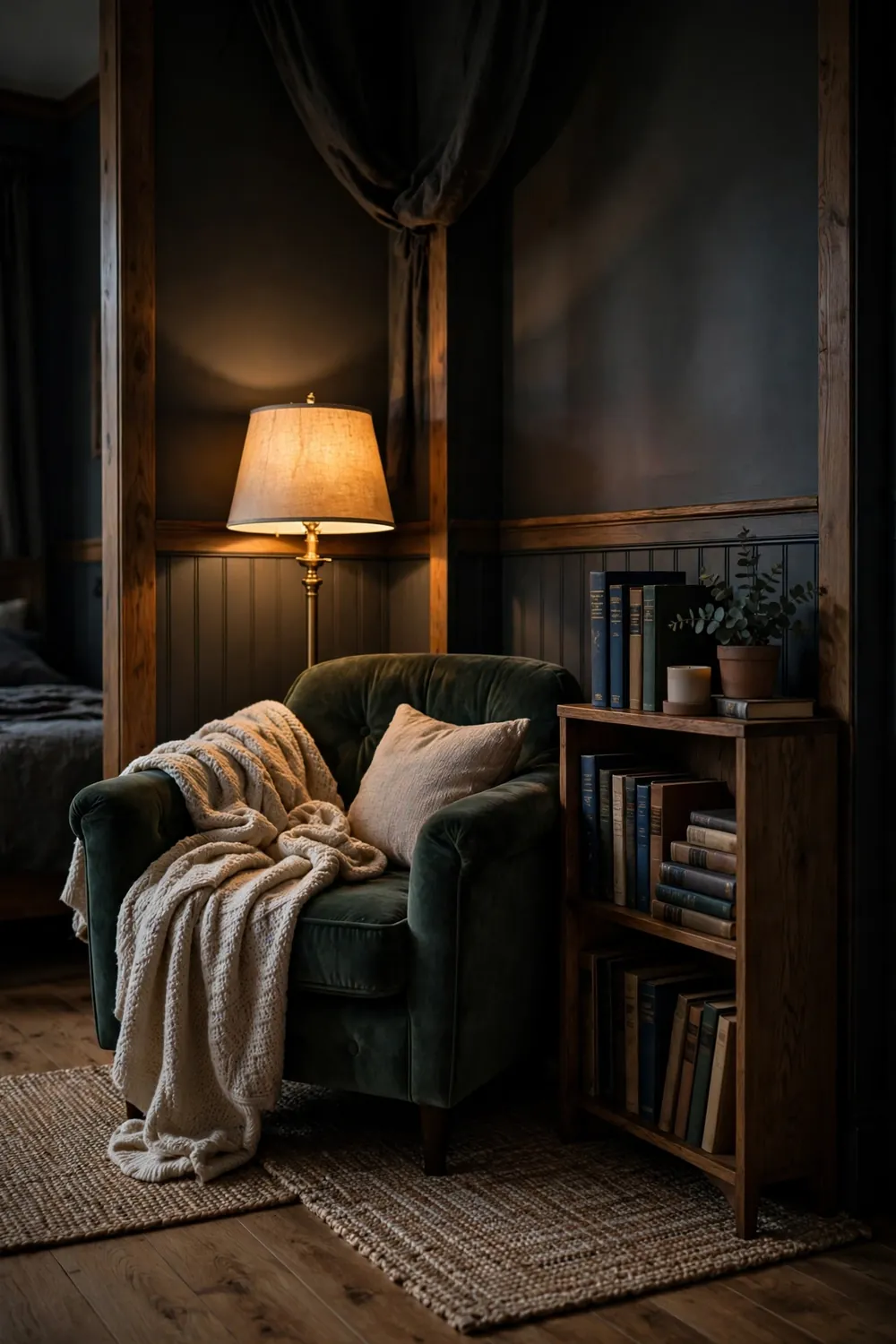
Every bedroom has a corner that gets the least light, and mine used to hold a laundry basket and nothing else. I moved a small armchair there, added a floor lamp with a warm bulb, and put a little bookshelf beside it, and that dead corner became the place I sit with tea in the evening. The darkness that made the corner useless for anything else is exactly what makes it good for reading.
A reading nook does not need much space, and it does not need to match the bed. My chair is a different color from the bedding, and that is fine, because the nook is its own little room inside the room. I keep a blanket on the chair arm and a small table for a mug, because a nook without somewhere to put a mug is a nook I will leave after ten minutes. The lamp is the most important part, and I chose one I can angle toward the book without lighting the whole room.
Tip: Put the nook lamp on a separate switch from the bed lamps, if you can. Reading light and sleeping light are different jobs, and one switch for both never suits both.
13. Hang Art in Dark Frames on a Dark Wall
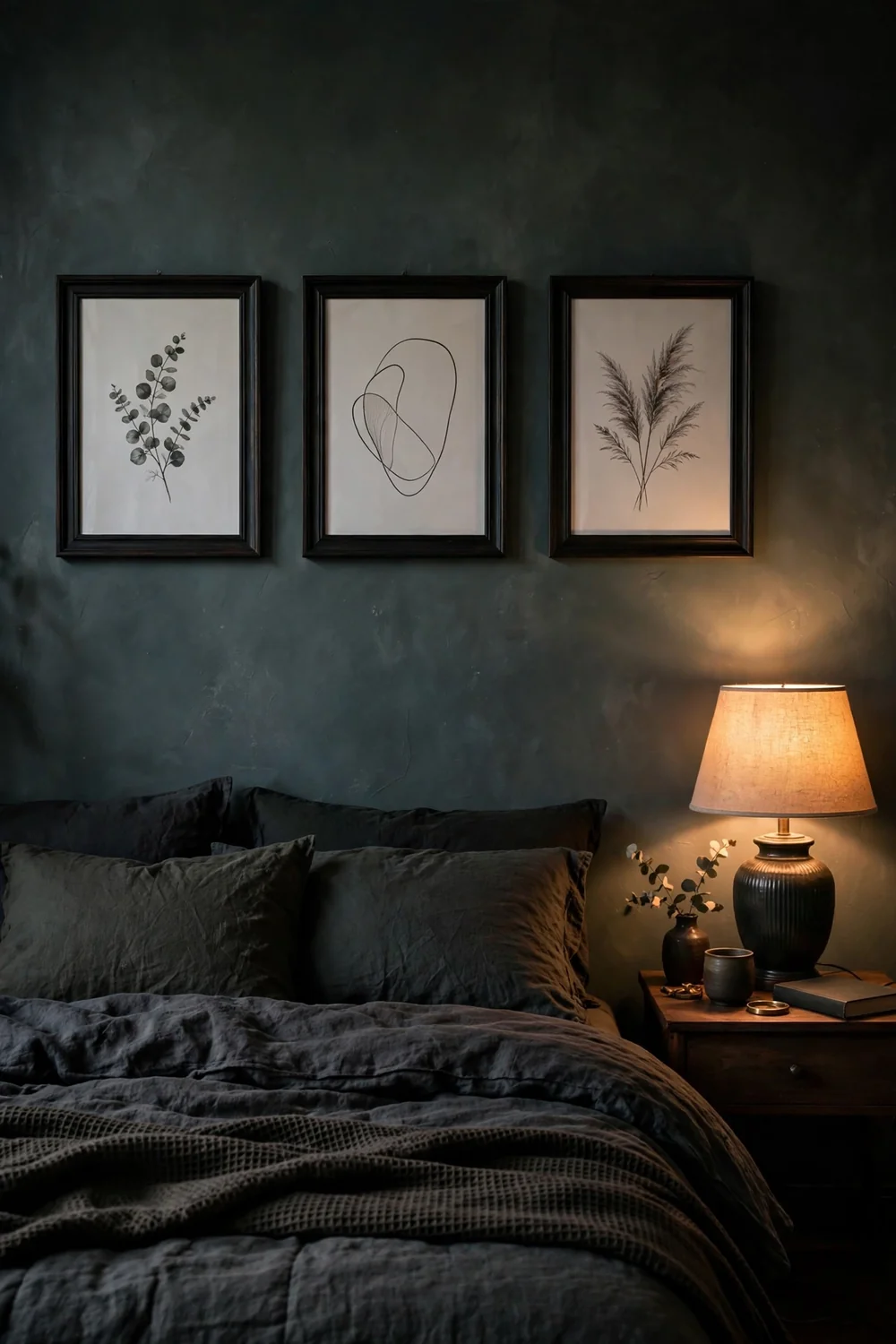
Art on a dark wall can disappear if the frames are wrong, and mine did at first. I hung pale prints in thin white frames on a charcoal wall, and they looked washed out, like holes in the wall. Dark frames fixed it. A black or dark wood frame sits quietly against the wall, and the picture inside it gets to be the lightest thing in that spot, so your eye goes straight to it.
I keep the art simple and personal, not a matching set from one shop. One landscape print I already owned, one framed photo from a trip, and one small drawing a friend gave me hang in a loose row above the bed. They do not match, and that is why they look like mine rather than like a display. A mantel works the same way as a display spot in a living room, and these spring mantel decor ideas show how a few grouped pieces can anchor a wall without crowding it.
Tip: Hang art a little lower than you think in a bedroom. You look at bedroom art lying down or sitting, not standing, so eye level from the bed is the right height.
14. Layer Rugs So Your Feet Land on Something Soft
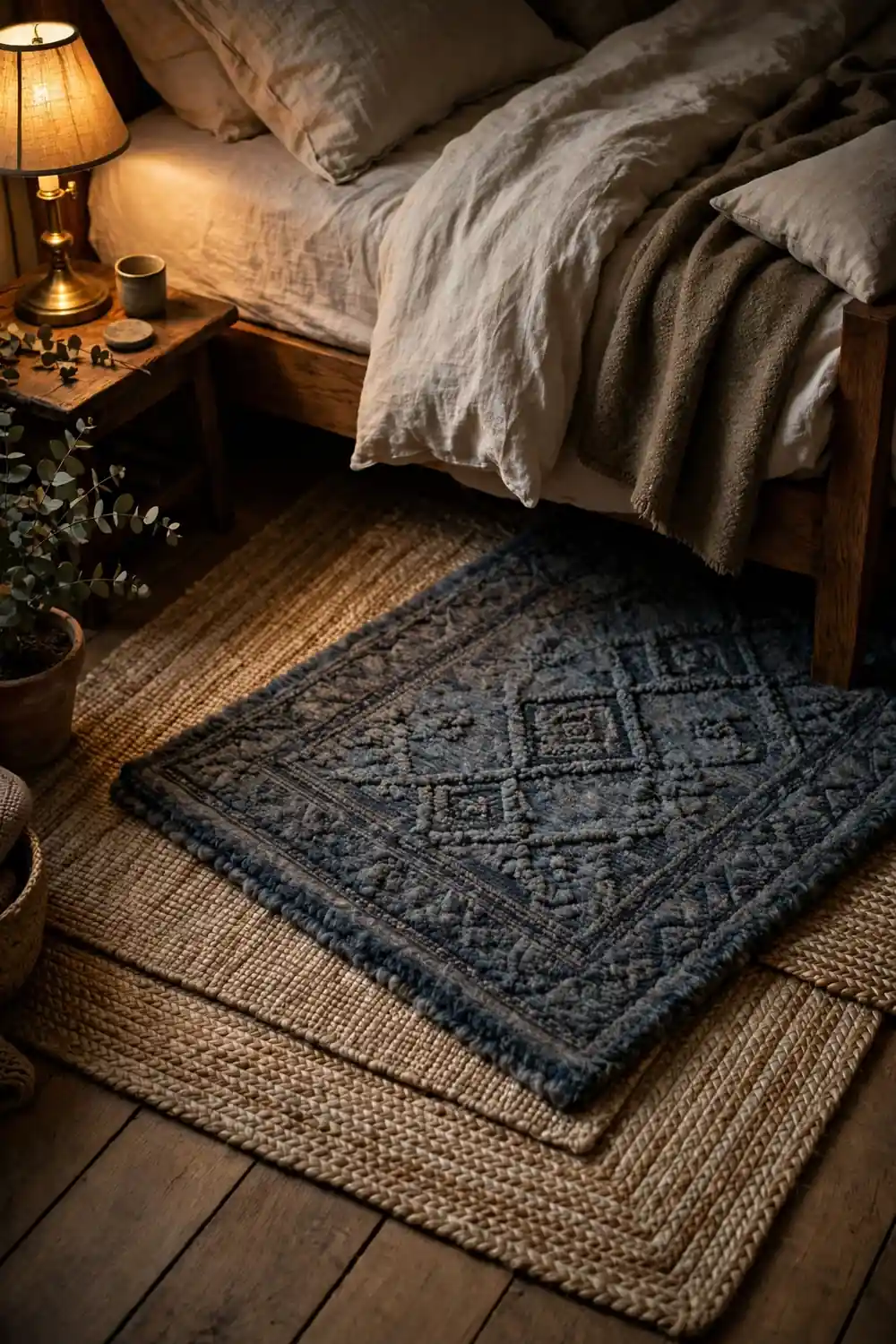
Cold floors ruin a moody bedroom faster than anything else, in my experience. I used to step out of bed onto bare wood in winter, and the shock of it woke me up in the worst way. Now I layer two rugs beside the bed, a flat woven one underneath and a thick wool one on top, and my feet land on something warm every morning. The layering also looks good, because the edges of the two rugs give the floor some shape.
Rug layering works the way layering works anywhere in a home, with a plain base and a softer piece on top. I keep the bottom rug plain and the top rug patterned, so the pattern has room to show without fighting the bedding. The same habit of layering a plain base with one softer piece shows up in table settings too, and these spring tablescapes use that same idea on a table, which is where I first noticed it. A rug that slips is a hazard, so I use a grip pad under the bottom rug, and I check it when I change the bedding.
Tip: Put the top rug where your feet actually land, not centred under the bed. A rug hidden under the bed helps no one in the morning.
15. Paint the Ceiling Dark for a Cocoon Feeling
Painting a ceiling dark sounds drastic, and I put it off for a year because of it. Then I tried it in a small bedroom, the same charcoal as the walls, and the room changed in a way wall paint alone never had. The ceiling stopped being a bright lid on a dark room, and the whole space felt like one cocoon instead of a box with a white top.
This idea suits a bedroom better than most rooms, because you spend a lot of time looking up in bed. A dark ceiling feels closer and calmer when you lie down, and it makes lamplight feel warmer because there is no white surface bouncing it back hard. If the idea scares you, try it in a small room first, or paint just the ceiling in a room that already has one dark wall. For more bedroom ideas to compare before you commit, the Real Homes bedroom ideas pages gave me a useful sense of how dark ceilings look in real homes, not just in styled photos.
Tip: Use a matte finish on a dark ceiling, not a shiny one. Shine shows every bump and brush mark, while matte paint hides them and keeps the ceiling soft.
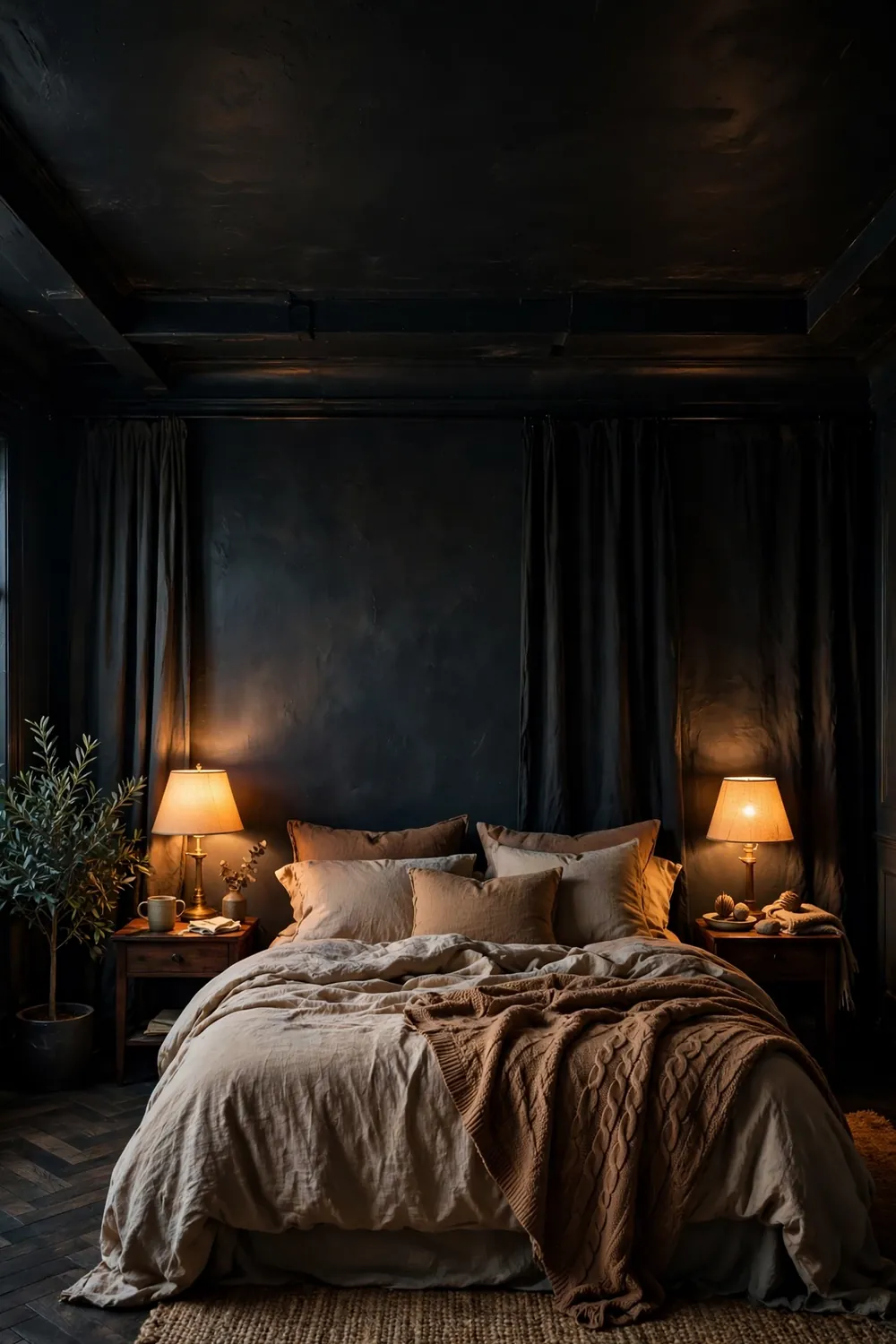
16. Add Brass and Amber for Warmth Against the Dark
Dark rooms need a warm metal the way a fire needs a spark, and brass is the one I reach for. A brass lamp, a small brass tray, and an amber glass vase on my bedside table catch the lamplight and throw it back in a warm glow. Without those touches, my dark room looked flat, even with good lamps, because nothing in it reflected the light back.
Amber glass works the same way for less money. A small amber vase or a candle holder in amber glass glows when a lamp sits behind it, and it costs far less than a brass lamp. I keep brass and amber to a few small pieces, not a whole collection, because too much shine in a dark room starts to look like a stage set. One lamp, one tray, and one vase is plenty in my room, and each one earns its place by catching light.
Tip: Put brass where a lamp can shine on it, not in a dark corner. Brass in shadow looks dull, while brass in lamplight looks warm.
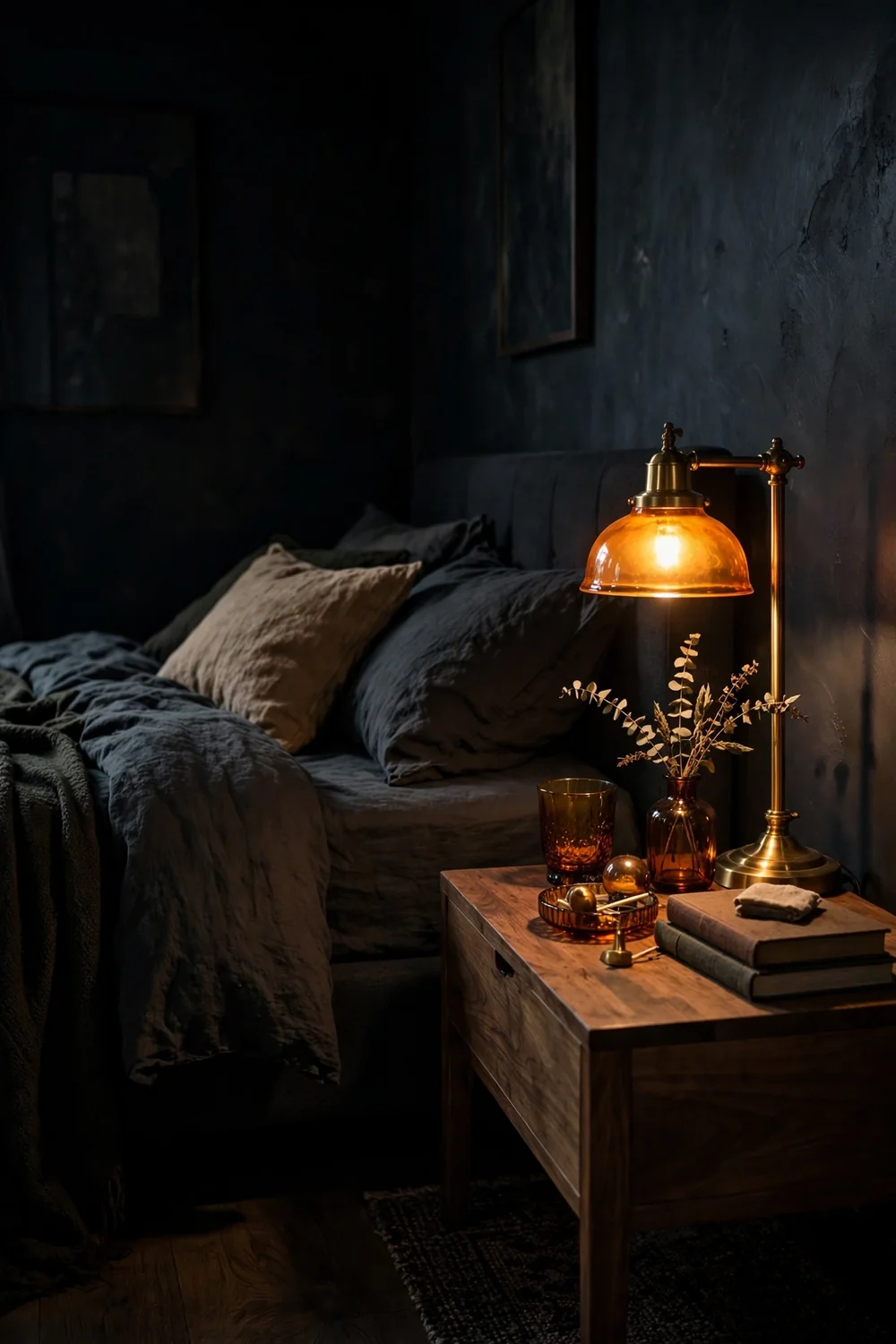
17. Build a Bedside Ritual, Not Just a Bedside Table
My bedside table used to be a dumping ground, with chargers, loose change, and books I never finished. I cleared it down to four things, a lamp, a book I am actually reading, a mug for tea, and a small tray for my phone, and the last hour of my day got calmer at once. The table is not just storage now. It is the start of a wind down routine.
A ritual sounds grand, but mine is small and a bit boring, which is why it works. I make tea, I put my phone on the tray face down, and I read for twenty minutes before I turn the lamp off. Some nights I skip the book and just sit, and that is fine too. The point is that the table supports the habit, instead of fighting it with clutter. A tray for the phone matters most, because a phone lying loose on the table gets picked up, and a phone in a tray feels put away.
Tip: Keep a charger in the tray, not loose on the table. A loose cable tangles with everything, while a cable in a tray stays out of the way.

18. Keep a Small Bedroom Moody Without Shrinking It
Small bedrooms and dark colors worry people the most, and I understand why. My smallest bedroom is also my moodiest, and it works because I kept the furniture low and the colors close together. A low bed, a low dresser, and walls and bedding in similar dark tones blur the edges of the room, so your eye travels further than the walls actually allow.
Mirrors help, but only one, and only placed well. I have one large mirror opposite the window, and it bounces daylight into the room in the morning without bouncing lamplight harshly at night. Several small mirrors, which I tried first, made the room feel busy and a bit confusing. I also keep the floor as clear as I can, because a small dark room with clutter on the floor feels cramped, while the same room with a clear floor feels like a den.
Tip: Choose a low bed frame for a small moody room. A tall frame eats the wall space a dark room needs to breathe, while a low frame leaves the wall color room to work.
Frequently Asked Questions
Will dark walls make my bedroom feel smaller?
They can, but in my experience they make it feel more enclosed rather than smaller in a bad way, if you keep the bedding light and the lamps warm. A dark wall behind the bed with cream bedding and warm light feels like a cocoon, not a cupboard. If the room still feels tight, keep the other walls lighter and let the dark wall be the only dark one.
What is the best dark color for a cozy bedroom?
There is no single best color, and I say that because I have tried three and liked each for a different reason. Charcoal feels modern and calm, navy feels softer in the morning, and deep green feels warm with wood. Paint test patches of each, look at them at night under your own lamps, and pick the one that feels calm to you, not the one that looks best in a shop.
How do I keep a moody bedroom from looking gloomy?
Warm light is the answer in my room, every time. Warm bulbs, lamps at bed height, and one or two warm accents like brass or amber glass stop a dark room from feeling cold. If the room still feels gloomy, add a plant or a cream throw, because green and cream both soften dark walls without breaking the mood.
Can a moody bedroom work in a small room?
Yes, and my smallest bedroom is proof, as long as you keep the furniture low and the floor clear. A low bed, one large mirror opposite the window, and colors that sit close together make a small dark room feel like a den rather than a box. Skip tall wardrobes against the dark wall if you can, because tall furniture in a small dark room is what makes it feel cramped.
A moody bedroom is not about buying a whole new room, and I did not do that myself. I started with one dark wall, then one lamp change, then one throw, and each small step taught me what I actually liked living with. Some ideas here will suit your room and some will not, and that is fine. The ones that suit you are the ones that make an ordinary evening feel a little warmer, a little quieter, and a little more like yours.
Pick the idea that fixes the thing that bothers you most, whether that is cold floors, harsh light, or a bed that never looks inviting, and try it this weekend. Live with it for a week, notice how you sleep and how you wake up, and then decide. A bedroom that grows one honest change at a time will always feel more restful than a room redone all at once to match a list.